Brand positioning is more than a marketing concept. It’s the perception customers form about what makes a business different, better, or more relevant than the alternatives. Through extensive work with hundreds of small business owners, Branded Agency has learned that the strongest positions aren’t created through guesswork or trend-chasing. They emerge from genuine strengths, real customer feedback, and the lived experience of what sets a business apart.
This page outlines Branded Agency’s field-tested approach to helping small businesses claim a distinctive place in their market. Readers will discover a clear explanation of what is brand positioning in today’s competitive landscape, why it has become essential for small business growth, and how to shape a position that reflects their values, resonates with the right audience, and delivers a sustainable competitive edge. It’s a practical, proven framework designed to help small businesses stand out with clarity — and stay top of mind where it counts most.
Quick Answers
What Is Brand Positioning?
Brand positioning is the strategic choice that defines how your business should be remembered—and why customers should choose you over anyone else. At Branded Agency, we see it as the anchor that guides every message, shapes every experience, and signals the unique value only your brand can deliver. In simple terms, it becomes the foundation of your brand hierarchy, influencing how every element works together.
It clarifies your core promise.
It differentiates you in a crowded market.
It helps your ideal customers instantly understand why you matter.
Top Takeaways
Brand positioning shapes how customers see your business.
Clear messaging improves recognition and consistency.
Know your audience deeply before defining your position.
Differentiate from competitors to stand out.
Review and refine your positioning regularly.
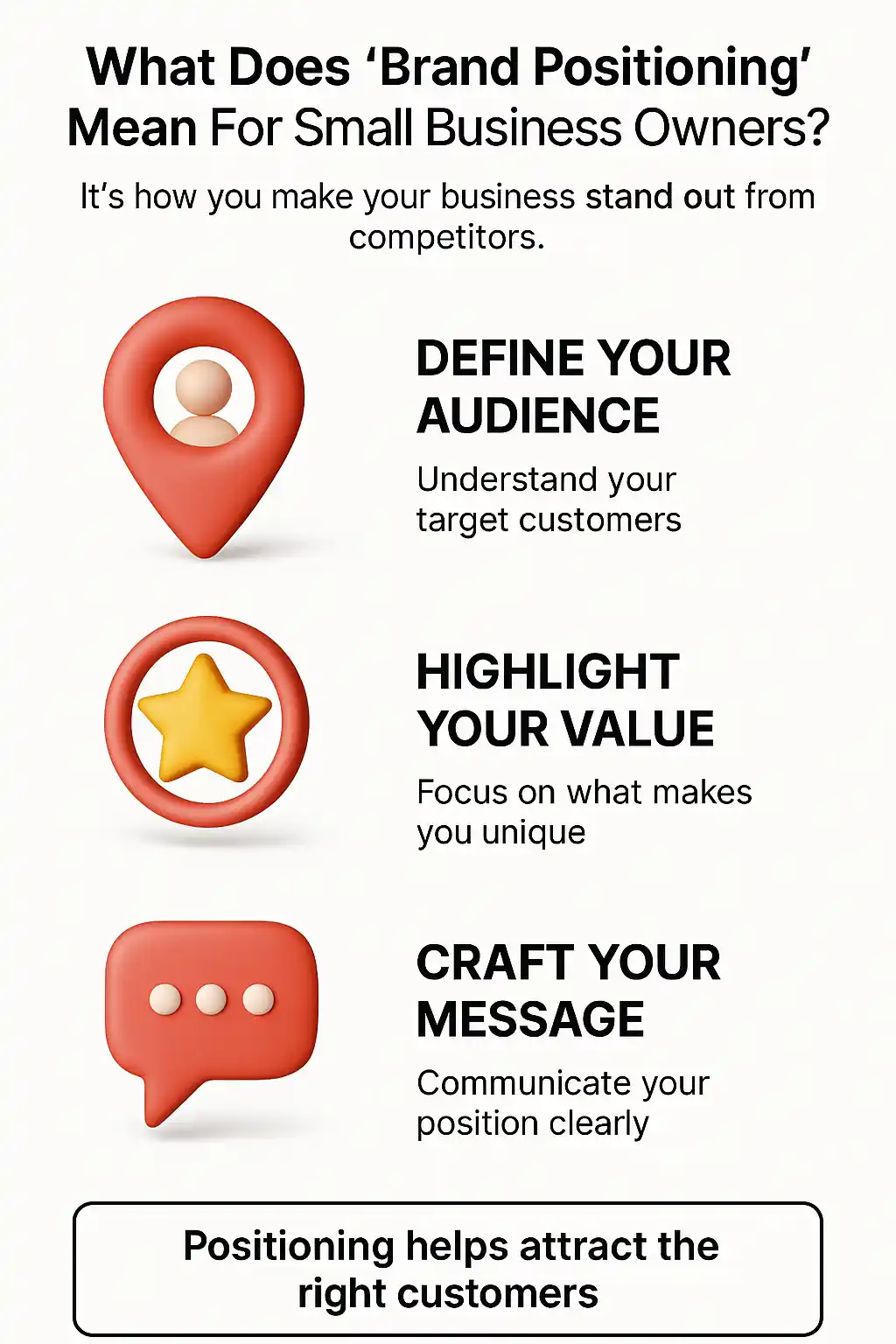
Brand positioning defines how your small business is perceived in the minds of your ideal customers — and that perception shapes everything from pricing power to customer loyalty. For small business owners, it’s not about trying to be everything to everyone. It’s about carving out a clear, memorable space that communicates why someone should choose you over a competitor.
At Branded Agency, we’ve learned through hands-on work with small teams and solo founders that effective positioning comes from three simple but powerful elements:
A clear point of difference
Customers choose brands they understand. When you articulate what makes you meaningfully different — whether it’s your process, personality, product quality, or philosophy — people can instantly recognize your value.A specific customer promise
Strong positioning tells customers what they can expect every time they interact with you. This promise becomes the backbone of your marketing, messaging, and service experience.Consistent proof
The brands that win aren’t just saying the right things — they’re consistently delivering on them. Testimonials, results, and repeatable experiences reinforce your position and build trust quickly, a pattern also seen among top marketing agencies that rely on proof to strengthen credibility.
For small business owners, strong brand positioning does more than attract attention — it helps you compete with bigger players, charge what you're worth, and create messaging that feels effortless because it reflects who you truly are. When supported by a well-defined brand platform that clarifies your core message, voice, and value proposition, your positioning becomes even more consistent and compelling across every marketing channel. When customers clearly understand your value, choosing your business becomes the easiest decision they make.
“After working with hundreds of small business owners, we’ve found that the strongest brand positions don’t come from trying to sound bigger or flashier — they come from uncovering what you already do exceptionally well and communicating it with clarity and consistency. When your positioning reflects your real strengths and lived experience, customers recognize the authenticity immediately — and that’s what creates lasting trust.”
Essential Resources to Understand Brand Positioning
1. DigitalOcean — A Practical Starting Point for Clearer Positioning
We often recommend this guide to clients who want a straightforward, no-fluff explanation of brand positioning. It breaks down the essentials in a way that helps you quickly connect the concept to your everyday business decisions.
Source: https://www.digitalocean.com/resources/articles/what-is-brand-positioning
2. The Branding Journal — The Cleanest, Quickest Definition You’ll Find
This resource delivers a crisp explanation of what brand positioning really means. It’s perfect when you need clarity fast — especially if you’re still shaping how you talk about your business.
Source: https://www.thebrandingjournal.com/2016/11/brand-positioning-definition
3. Amazon Ads Guide — Positioning Through a Commercial Lens
If you sell products or run ads, this guide shows how positioning influences buying behavior. We like it because it ties strategic branding directly to real-world customer decisions.
Source: https://advertising.amazon.com/library/guides/brand-positioning
4. Upwork Guide — A Modern Approach for Competitive Markets
This is a resource we share with service-based clients who need to carve out a lane online. It outlines a current, practical framework that helps you refine your niche and strengthen how you show up in crowded categories.
Source: https://www.upwork.com/resources/brand-positioning-guide
5. Perlego Academic Overview — The “Why It Works” Behind Positioning
When you’re ready to dive deeper, this resource explains the psychology behind how customers perceive your brand. It’s a useful layer of insight for owners building a more intentional and informed strategy.
Source: https://www.perlego.com
6. Kellogg on Branding — A Strategic View for Long-Term Growth
We draw from this text when helping clients reshape or evolve their brands. It offers expert guidance on building and sustaining a strong position as your business grows and your market shifts.
Source: https://www.oreilly.com/library/view/kellogg-on-branding/9781119533184
7. Routledge Framework — A Complete Guide to Aligning Strategy and Messaging
This is a go-to for understanding how your identity, values, and communication all work together. It’s especially helpful if you’re ready for a more structured, research-backed approach to positioning your brand the right way.
Source: https://www.routledge.com/Brand-Positioning/Kostelijk-Alsem/p/book/9780367250119
Supporting Statistics
Small Businesses Dominate the Market
99.9% of U.S. firms are small businesses.
The market is overwhelmingly crowded — and without clear positioning, your brand blends in instantly.
At Branded Agency, we see this daily: businesses without a defined position are forgotten before they ever get noticed.
(Source: Pew Research Center – small business insights)
At Branded Agency, we see this daily: businesses without a defined position are forgotten before they ever get noticed.
(Source: Pew Research Center – small business insights)
Trust Determines Buying Decisions
81% of consumers must trust a brand before they buy.
46% buy more from brands they already trust.
In our client work, we consistently see that strong, consistent positioning is one of the fastest ways to build trust — and convert it into measurable sales.
(Source: Believe in Banking – consumer trust research)
46% buy more from brands they already trust.
(Source: Believe in Banking – consumer trust research)
Reputation Drives First Impressions
54% of consumers rely on online reviews as their first trust signal.
When your positioning aligns with what customers actually experience, your reviews reinforce your credibility.
But when there’s a disconnect, reviews expose it instantly — often publicly.
(Source: BusinessWire – online review impact study)
But when there’s a disconnect, reviews expose it instantly — often publicly.
(Source: BusinessWire – online review impact study)
Final Thought & Opinion
Brand positioning is more than messaging — it’s the foundation of how your business earns trust, attention, and loyalty.
What We’ve Seen Firsthand at Branded Agency
The small businesses that grow fastest aren’t the biggest or flashiest.
They’re the ones that own what they do best and communicate it clearly.
Consistency — not complexity — is what makes customers believe in you.
The small businesses that grow fastest aren’t the biggest or flashiest.
They’re the ones that own what they do best and communicate it clearly.
Consistency — not complexity — is what makes customers believe in you.
Why Positioning Matters
The market is overcrowded. Clear positioning cuts through the noise.
Trust is fragile. A defined position helps you build it faster.
Customers choose brands they understand — and remember.
The market is overcrowded. Clear positioning cuts through the noise.
Trust is fragile. A defined position helps you build it faster.
Customers choose brands they understand — and remember.
Our Opinion
Positioning isn’t about inventing something new. It’s about confidently amplifying your real strengths. When your internal clarity matches your external message, three things happen:
Your marketing becomes easier.
Your message becomes sharper.
Your customers become more loyal.
Bottom line: Small businesses stand out not by trying to be something they’re not, but by leaning into what they already do exceptionally well — and positioning it with intention.
Your marketing becomes easier.
Your message becomes sharper.
Your customers become more loyal.
Next Steps
1. Reassess Your Brand Positioning
Review your message, visuals, and customer perception.
Spot gaps between promise and experience.
Review your message, visuals, and customer perception.
Spot gaps between promise and experience.
2. Validate With Audience Insights
Gather real customer feedback.
Identify repeating themes.
Gather real customer feedback.
Identify repeating themes.
3. Align All Messaging
Update website and marketing assets.
Keep language consistent everywhere.
Update website and marketing assets.
Keep language consistent everywhere.
4. Boost Trust Signals
Showcase reviews and case studies.
Make proof points easy to find.
Showcase reviews and case studies.
Make proof points easy to find.
5. Compare Against Competitors
Study their positioning.
Highlight what makes you different.
Study their positioning.
Highlight what makes you different.
6. Test and Refine
Run small messaging tests.
Keep what works. Adjust what doesn’t.
Run small messaging tests.
Keep what works. Adjust what doesn’t.
7. Build a Brand Framework
Document your promise, values, and voice.
Use it to guide future decisions.
A strong brand foundation built through consistent positioning, audience validation, and refined messaging also becomes the starting point for any effective brand extension strategy, ensuring future offerings feel aligned, credible, and trusted by your customers.
Document your promise, values, and voice.
Use it to guide future decisions.
FAQ on What Is Brand Positioning
Q: What does brand positioning mean?
A:
Defines how customers perceive your business.
Acts as a mental shortcut that clarifies your value.
Helps your brand occupy a distinct space in the market.
Q: Why is brand positioning important for small businesses?
A:
Levels the playing field against bigger competitors.
Improves clarity, credibility, and customer fit.
Reduces wasted spend by attracting the right audience.
Q: How do I create a strong positioning statement?
A:
Know your audience.
Analyze competitors.
Identify one core differentiator.
Distill it into a single clear promise.
Q: What are common mistakes?
A:
Being vague.
Mimicking competitors.
Trying to appeal to everyone.
Avoiding clear differentiation.
Q: How often should positioning be updated?
A:
Review yearly.
Adjust with market shifts.
Update when offerings or audiences change.
A:
Defines how customers perceive your business.
Acts as a mental shortcut that clarifies your value.
Helps your brand occupy a distinct space in the market.
A:
Levels the playing field against bigger competitors.
Improves clarity, credibility, and customer fit.
Reduces wasted spend by attracting the right audience.
A:
Know your audience.
Analyze competitors.
Identify one core differentiator.
Distill it into a single clear promise.
A:
Being vague.
Mimicking competitors.
Trying to appeal to everyone.
Avoiding clear differentiation.
A:
Review yearly.
Adjust with market shifts.
Update when offerings or audiences change.