You finished the game. You hit publish on itch.io and waited. The silence that follows, the days when downloads barely move, is the part nobody warns solo designers about. Designing the game was the work you signed up for. Getting players to find a one-person journaling title, parked on a storefront beside thousands of others, is the work you didn’t.
Here’s the good news. You don’t need a marketing team to fix it. A single creator with a clear plan and a few cheap, repeatable habits can build real momentum. This guide covers how to market a solo TTRPG and actually get it noticed.
TL;DR Quick Answers
DnD and TTRPG Marketing
DnD and TTRPG marketing is how you get a tabletop role-playing game in front of the right players and give them a reason to buy it, play it, and recommend it. What separates games that sell from games that stall is specificity, not budget. A creator who can name their exact player in one sentence will usually outperform one with deeper pockets and a vaguer pitch.
What effective TTRPG marketing comes down to:
Know your player. Pin down the sub-niche, mood, and system your game serves before you promote anything.
Sell where players look. itch.io rewards discovery, DriveThruRPG rewards search, and Kickstarter doubles as a launch event.
Build an audience early. A small email list and community before launch day beats a cold release.
Show the game in action. Playthrough clips, journal entries, and devlogs do the convincing that description can't.
Earn word of mouth. Reviewer copies and ratings from happy players carry a niche game further than paid ads.
Top Takeaways
The whole guide in one screen, plus the idea to keep:
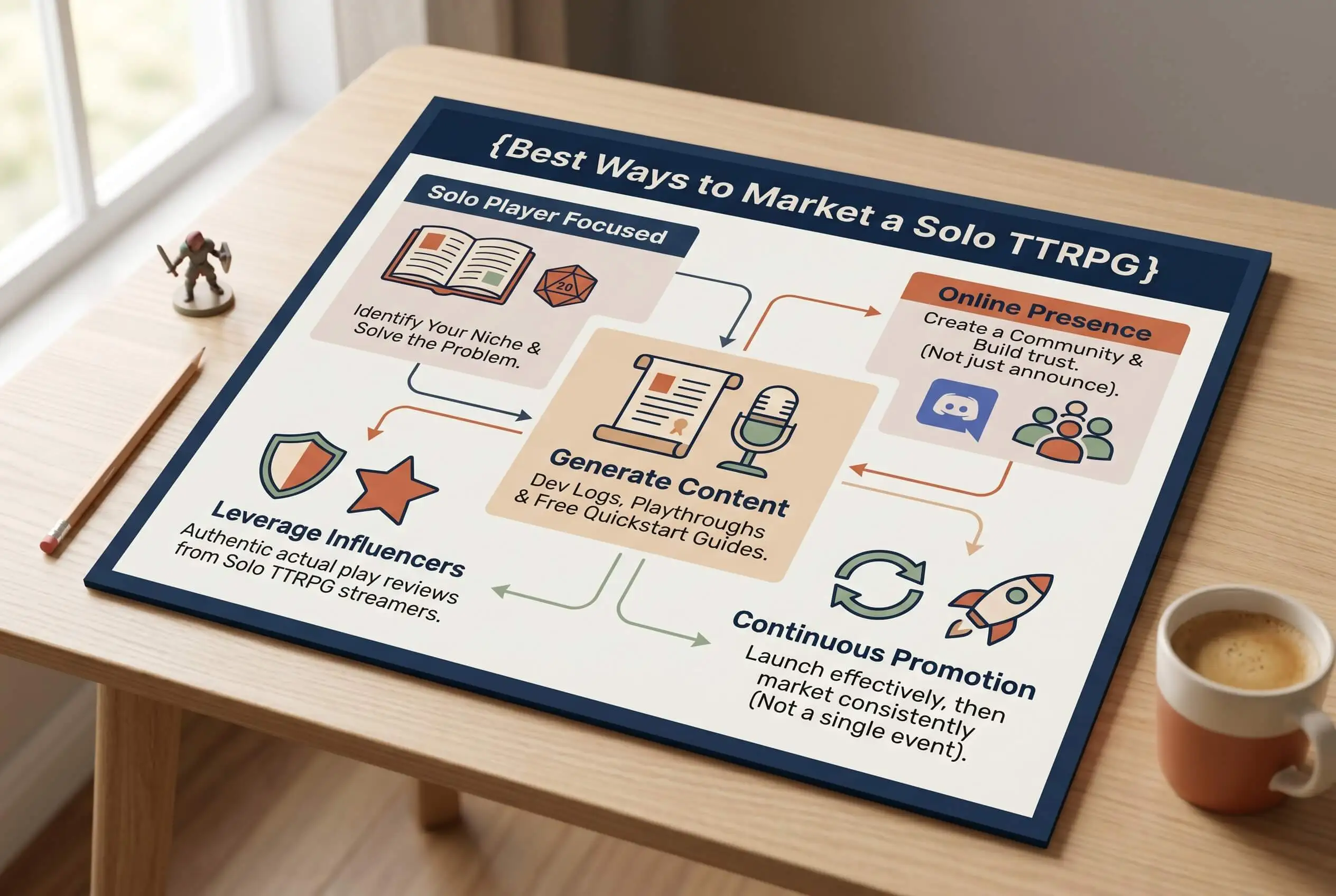
Know your player before you promote. Solo games serve specific moods, so pick a sub-niche and name it in one clear sentence.
Choose a storefront that helps discovery, and treat your product page as the ad it really is.
Build a genuine community and an email list well before launch day.
Show the solo experience with journal entries, photos, and short-form video. Don’t just describe it.
Launch like an event, using crowdfunding, reviewer outreach, and community copies to build momentum.
Specificity and consistency beat budget and volume, every time.
Good promotion is really just careful marketing aimed at a niche you understand from the inside. And if you’d rather keep your focus on design and hand the rest to a specialist, help exists for this exact corner of the tabletop.
Start With the Player, Not the Promotion
Before you promote anything, get specific about who plays solo games. Solo players don’t form one tidy audience. Some want a cozy, reflective journaling session on a Sunday night. Others want the slow dread of a Wretched and Alone survival story, an oracle-driven adventure, or a fast roll-and-write dungeon crawl. Different moods, different buyers.
Pick the sub-niche your game actually serves, then describe it plainly. Once you can name your player, every later choice gets easier: which tags to use, which communities to join, what feeling your cover and tagline need to sell, and even how thoughtful board game copywriting services can help communicate your game’s identity more clearly. We see the same mistake again and again. A good solo game stays invisible because its positioning tries to please everyone, and a game built for everyone reaches no one in particular.
Pick a Storefront That Helps People Find You
Where you sell shapes how players find you. For solo and journaling TTRPGs, itch.io is usually the right home. It runs on tags, it’s easy to browse, and it leans on community bundles and pay-what-you-want pricing, so curious players turn up games they were never searching for. DriveThruRPG works differently. It’s search-led and the standard for print-on-demand, with category charts that a well-priced title can climb. Many creators simply use both.
Whichever you pick, treat the product page as your most important ad, because it is one. A sharp cover image, a one-line tagline that sells the feeling, a sample page or two, and a plain note on what someone needs to start playing will move more copies than any single social post. Tag it honestly while you’re at it. Players hunt for solo games by mood and mechanic, so ‘journaling,’ ‘solo,’ and your genre all need to be on the page.
Build a Small Community Before Launch Day
The strongest launch days belong to creators whose audience already exists. Start something simple, a Discord server or, better still, an email newsletter, and begin collecting interested readers months before release. An email list is the one channel you fully own. No algorithm gets to quietly bury it.
So spend real time where solo players already gather: dedicated subreddits, Discord servers, design forums. Show up as a member, not an advertiser. Answer questions, post what you’re figuring out, talk up other people’s games. Then, when you finally mention your own title, it reads as news from a familiar name instead of a cold sell. A warm community of a few hundred will out-pull a large, indifferent following every single time.
Show Players the Solo Experience
A group game can sell itself with an actual-play stream. Solo play is quieter and more interior, so showing it off takes a bit of imagination. Share your own playthrough. Post a journal entry that gives you chills, a photo of your filled-in pages, a 30-second clip of you flipping through the zine. Short-form video earns its place here, because watching the journaling happens says more in half a minute than a full paragraph of description ever will.
Keep a devlog as you build, and write the occasional designer diary. That gives followers a reason to stick around and gives search engines fresh pages to index. The principle behind all of it is generosity. Content that helps, teaches, or simply charms someone earns attention the honest way, and it travels further than a straight sales post. Every time a post does something for the reader, it quietly markets your game too.
Launch With Momentum
Treat your release as an event, not a quiet upload nobody noticed. Crowdfunding is a marketing tool as much as a funding one, and Kickstarter runs an annual ZineQuest window that suits small solo titles well. Put up a pre-launch page early so you can gather followers before the campaign opens. Then day one starts with a crowd instead of an empty room.
Line up a handful of reviewers, streamers, or bloggers ahead of time and get early copies into their hands. Offer community copies so word of mouth has a place to start. And ask your happy players, warmly and directly, to leave a rating or pass the game along, because recommendations almost never happen on their own. They happen when you make them easy.
“The solo designers who do well almost never have the biggest budget. What they have is a clear answer to one question: who is this for, and how should it make them feel? I’ve watched plain little journaling games outsell glossy, expensive releases, simply because the creator could describe their player in one sentence and then showed up, week after week, in the few places that player already spent time. Marketing a solo game rewards the most specific voice in the room, not the loudest.”
7 Essential Resources
Here’s where to go deeper. These seven cover the practical side of getting an indie tabletop game in front of players, from audience strategy to the storefronts where your game will actually live.
Storytelling Collective: Marketing 101 for TTRPG Creators. A marketing course built specifically for indie tabletop creators. It covers audience, branding, and how to promote your work without dread.
Failure Tolerated: A Crash Course on Marketing Your Indie RPG. A working designer’s honest, practical guide. It reframes marketing as something a creator can do without feeling like a sellout.
The Indie RPG Newsletter: The Big List of TTRPG Marketing Wisdom. A running roundup of marketing advice, tactics, and tools, pulled together from across the indie tabletop community.
itch.io Solo RPG Tag. The browse page where solo games actually live. Study how published titles handle covers, taglines, and tags, then make yours hold its own.
Polyhedra Games: How to Design and Publish Your Own Tabletop RPG. A start-to-finish walkthrough of production, platforms, and the work of getting a finished game in front of players.
TTRPG Marketing Q&A. A panel of working RPG designers answering blunt questions about ads, audiences, and reaching players outside your current circle.
Konvoy: Unlocking Role-Play for the Masses. A sharp look at why tabletop roleplaying grew so fast, with lessons on tooling, onboarding, and lowering the barrier for new players.
3 Statistics
Three numbers worth knowing, and what each one means if you’re the whole team.
The global TTRPG market hit an estimated $1.9 to $2.0 billion in 2024, and the growth is moving toward digital sales, crowdfunding, and direct-to-consumer channels rather than shop shelves (RPG Drop: Worldwide TTRPG Market in 2024). That shift works in your favor. The fastest-growing parts of the market are the ones a solo creator can reach without a distributor.
On Kickstarter, the average funded tabletop project raised about $41,400 in 2024. That’s the lowest per-project average since 2014, even though more than 5,300 tabletop projects got funded that year (BoardGameWire). Read that two ways, because both are true. Most funded projects are modest, and the field is crowded, so a sharp and specific pitch matters more than it used to.
In indie tabletop crowdfunding, Meta’s platforms still give the best return on paid ad spend, and the cost to land a backer often runs around $15 to $30 (RPG Drop: Marketing Channels for Indie TTRPG Kickstarter). If you do put money into ads, start small and target by interest. Scale up only once your storefront page is reliably turning visitors into buyers.
Final Thoughts and Opinion
So here’s our honest opinion. Solo TTRPGs reward the specific and the consistent far more than the loud or the well-funded. If your time is short, put it here first: write one clear sentence that names your player, make your storefront page genuinely good, and open your email list today, before the game is even finished.
Everything else, short-form video, crowdfunding, reviewer outreach, works better once those basics hold. And yes, marketing a solo game can feel uncomfortable, especially if you’d rather design than promote. We get that. But promotion done well is just helping the right people find something they’ll love, which is the same reason many black-owned marketing agencies focus so heavily on authentic audience connection instead of broad, forgettable messaging. Treat it as part of the craft instead of a chore bolted on at the end, and the game finds the audience it earned.

Frequently Asked Questions
How do I market a solo TTRPG with no budget?
Focus on free habits you can repeat. Get clear on your audience, tighten your storefront page, start an email newsletter, and join the communities where solo players already hang out. Post playthrough content and devlogs on a schedule you can keep. Most solo launches that work run on time and specificity, not ad budget.
Should I sell my solo TTRPG on itch.io or DriveThruRPG?
Plenty of creators use both, and that’s a fine answer. itch.io is tag-driven and easy to discover through, which suits solo and journaling games and pay-what-you-want pricing. DriveThruRPG is search-led and the go-to for print-on-demand. Starting on itch.io and adding DriveThruRPG when you’re ready for print is a sensible, common path.
How is marketing a solo RPG different from marketing a group game?
Group games lean on the social hook and on actual-play streams. Solo play is quieter, so those tactics won’t carry it. You’re selling a mood and a personal experience instead, and you show it through journal entries, photos, and short clips rather than a livestreamed group session.
Do solo TTRPGs perform well on crowdfunding?
They can, especially small zines launched during Kickstarter’s ZineQuest window. Solo titles usually cost little to produce, so funding goals stay modest and reachable. Build a pre-launch follower list first. Campaigns that open with an audience already in place consistently beat the ones that start cold.
How do I get reviews for my solo TTRPG?
Reach out to reviewers, bloggers, and streamers who already cover solo or indie games, and get free copies to them well before launch. Offer community copies on itch.io so new players can try the game and talk about it. Then ask the players who enjoyed it, directly, to leave an honest rating.
How long does it take to build an audience for a solo TTRPG?
Usually months, not weeks. Audience building is slow by nature. A newsletter grows a little at a time, community trust adds up, and your content keeps working long after you post it. The creators who get there start early and stay consistent, treating promotion as a habit rather than a launch-week sprint.
Ready to Get Your Solo TTRPG Noticed?
Your game deserves players. Pick one move from this guide and do it today, before you close the tab. Write the single sentence that names your ideal player, or set up a free email signup page for your next release. Tomorrow, do the next thing. That’s how momentum works.
If this guide helped, here’s how to keep it going. Subscribe for more marketing playbooks built for small creators, pass it to a designer who needs it, and tell us in the comments which solo TTRPG you’re working on right now. The same way a freelance healthcare content writer grows by understanding a specific audience deeply, successful TTRPG creators grow when they speak directly to the exact players their game is built for.