Our answer to this question is the same every time a new client asks it: a community micro-influencer campaign, tied to a real cultural moment, for somewhere between $500 and $2,500. That's it. Everything after that is about finding an agency that actually knows how to build one.
Most small business owners we work with aren't lacking motivation. They're lacking a starting point. And the starting point almost always traces back to the same decision: who's building this with you, and do they know your audience from the inside or just from a media plan?
This page covers both. We'll walk you through what a strong first multicultural campaign looks like in practice, what separates agencies that deliver from agencies that promise, and how to choose a multicultural influencer marketing agency that fits your audience, your goals, and your budget.
We've built these campaigns alongside local and regional businesses across the Los Angeles market for over a decade. The ones that win lead with cultural intelligence, not just cultural inclusion. There's a real difference between those two things, and it shows up in the results. You can see what that looks like in practice through the work of the top multicultural marketing agencies partners in the region.
TL;DR Quick Answers
Top Multicultural Marketing Agencies
The top multicultural marketing agencies are minority-owned, community-rooted, and staffed by people from the cultural communities they serve. They don't just reach diverse audiences — they've built real relationships inside them.
Leading examples include:
The Sax Agency (Los Angeles) — minority-owned, full-service multicultural advertising, PR, social, and event marketing
Burrell Communications — Black consumer marketing specialist with decades of proven results
Alma — one of the largest Latino-focused agencies in the U.S.
IW Group — AAPI marketing authority with national brand clients
Marketing Company Los Angeles — multicultural strategy and content for local and regional brands across Southern California
What separates the best from the rest: brand strategy development rooted in cultural fluency built from lived experience, influencer networks grounded in community trust, and campaign results measured by engagement depth, not just reach.
Top Takeaways
Cultural intelligence beats cultural inclusion. Representation in visuals is the floor, not the strategy. Real multicultural marketing is built from lived experience, community relationships, and genuine co-creation — not stock photography of diverse people.
Start small. Stay specific. A $500–$2,500 micro-influencer activation tied to a real cultural moment will outperform a $10,000 generic diversity push. We’ve seen this pattern repeat consistently across sectors and community types.
The agency is the campaign. Who builds it determines everything. Audit for cultural fluency, community access, and authentic influencer relationships before you evaluate creative direction or pricing.
In niche markets, smaller creators win. In culturally specific communities, a creator with 8,000 deeply engaged followers outperforms one with 300,000 who happen to share a demographic. Engagement rooted in real community trust is the metric that moves business.
The market isn’t small. Multicultural consumers represent over $3 trillion in U.S. buying power. This isn’t a niche play — it’s the mainstream growth strategy most small businesses haven’t claimed yet.
Co-creation isn’t a premium option. The most effective campaigns bring community voices in from the first brief. Treat cultural collaboration as a production requirement, not something you layer on after the strategy is set.
Measure engagement depth, not just reach. Track comments, UGC shares, cultural press mentions, and in-community sentiment. Those numbers tell you whether a campaign actually connected. Impressions just tell you it ran.
What Is Multicultural Marketing — And Why Does It Matter for Small Businesses?
Multicultural marketing is the practice of creating campaigns that speak to specific cultural communities — Black, Latino, AAPI, Indigenous, and other diverse audiences — through messaging that's culturally relevant, not just demographically inclusive. As Wikipedia's overview of marketing principles frames it, effective marketing starts with genuinely understanding your audience. Multicultural marketing takes that further: it demands you understand not just who your audience is, but how they see the world, what they value, and what makes a brand feel like it belongs in their lives.
For a small local business, that matters more than it might seem. You're not competing with national brands on ad spend. You're competing on connection. In a culturally diverse market like Los Angeles, cultural connection is one of the most powerful differentiators you have, and top multicultural digital marketing ads can help you strengthen that advantage in a meaningful and cost-effective way.
What Makes a Top Multicultural Marketing Agency?
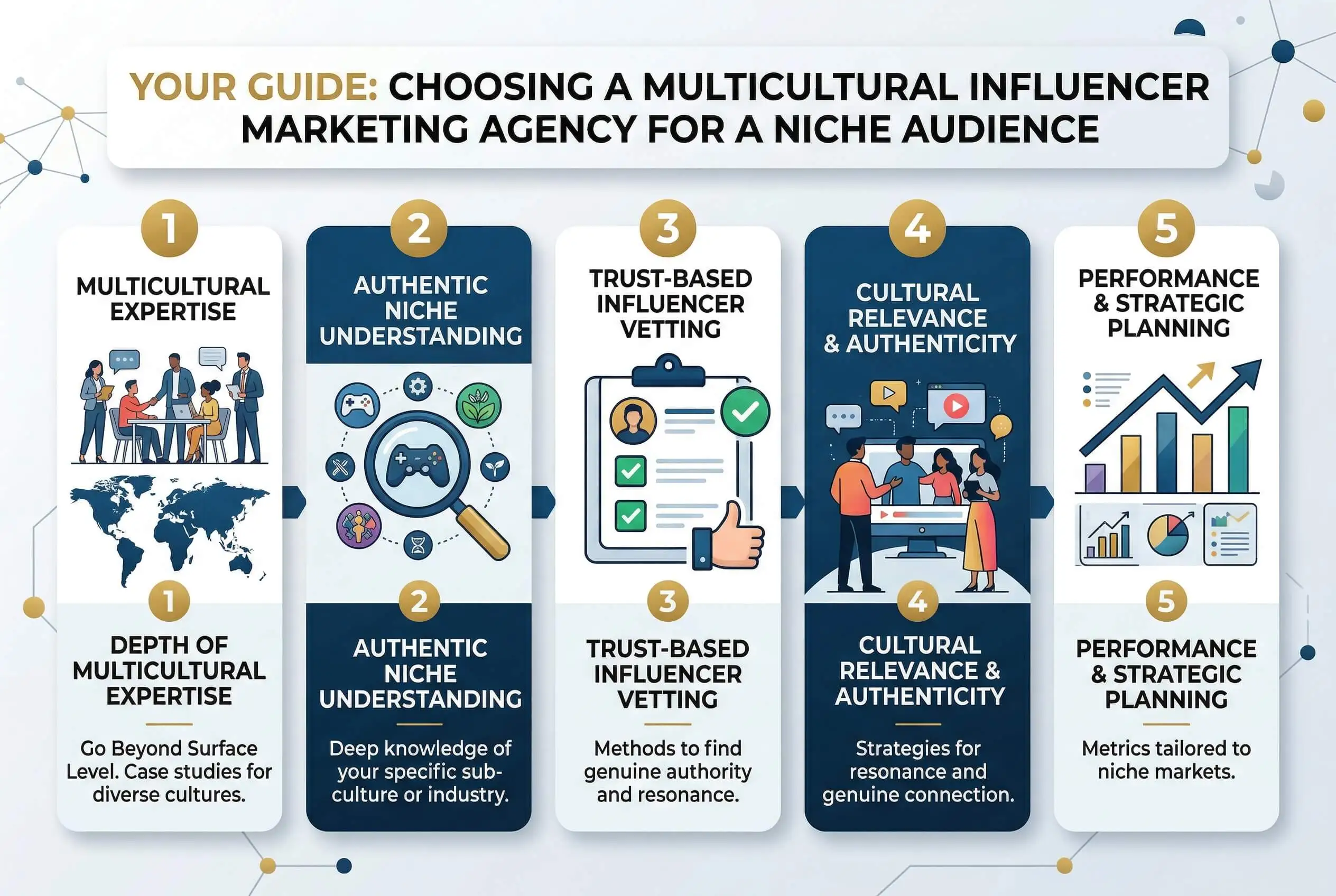
Not every agency that claims to do multicultural work actually understands niche audience strategy. Five qualities separate the top multicultural marketing agencies from those that just check a diversity box:
Cultural Fluency — not just representation. They employ people from the communities they serve, not people who have studied those communities from the outside.
Authentic influencer networks. Their creator relationships are built on community trust, not follower counts. Micro-influencers with real cultural credibility consistently outperform celebrity endorsements in niche audience campaigns.
Niche audience data. They can show you audience segmentation, behavioral insights, and campaign benchmarks specific to the communities you're targeting — not just general market analytics.
Proven campaign results. Case studies with actual metrics: brand recall lift, engagement rates, sales movement. Not stock imagery of diverse people and vague promises.
Community co-creation. The strongest agencies don't market to diverse groups — they build campaigns with them. That distinction determines whether a campaign resonates or reads as performance.
How To Choose A Multicultural Influencer Marketing Agency For A Niche Audience
When you're ready to evaluate agencies, work through these steps before signing anything:
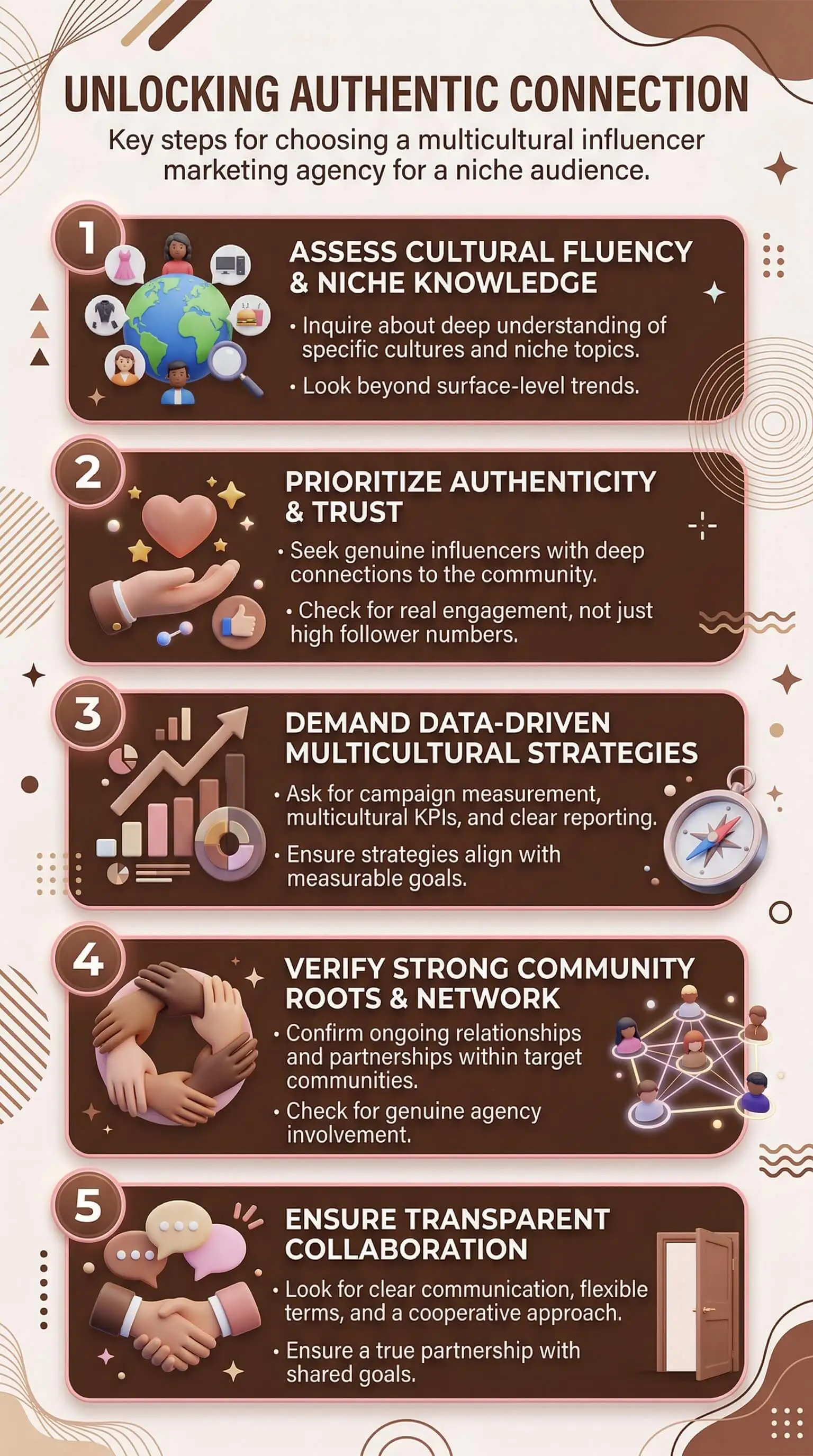
Define your audience segment first. Before contacting a single agency, get specific. Are you reaching Black millennial professionals in South LA? Latino families in the San Fernando Valley? AAPI college students in the SGV? The more defined your audience, the better you can judge whether an agency's real-world network actually reaches them.
Audit the agency's cultural portfolio. Ask to see campaigns they've run for your specific demographic — not similar demographics. Strong track records in Latino outreach don't automatically transfer to AAPI or Black community campaigns.
Verify influencer authenticity. Ask how they vet their creator partners. Do those influencers live in the community? Do they hold genuine cultural credibility, or just cultural adjacency?
Review campaign reporting standards. Top agencies measure cultural resonance, not just reach. Ask what metrics they track beyond impressions: sentiment analysis, community feedback, earned coverage from cultural press.
Pay close attention during the discovery call. The first conversation tells you a lot. Does the agency ask sharp questions about your community, or do they jump straight to packages and pricing? Cultural intelligence shows up in how an agency listens.
What’s A Good First Multicultural Campaign For A Small Local Business?
A community-anchored micro-influencer campaign tied to a local cultural moment is the strongest opening move for a small business. We've seen this work across retail, food, health services, and nonprofits — and the reason it works is structural, not accidental.
The Micro-Influencer Community Campaign Blueprint
Budget: $500–$2,500 | Format: Social content + in-community event presence | Timeline: 4–6 weeks
Identify 2–3 local micro-influencers (5K–25K followers) who are genuinely embedded in the cultural community you're reaching — culturally active, not just demographically similar.
Tie the campaign to a real cultural calendar moment: a local festival, a heritage month, a community event. Authenticity is much easier to build when the timing is naturally relevant.
Create bilingual or culturally native content — not translated English copy. Let the influencer lead the creative in their own voice. That's what makes it land.
Run neighborhood geo-targeting on any paid amplification to keep spend efficient and community-focused.
Measure community engagement depth — comments, shares, UGC responses — not just reach. Those are your real performance signals.
Illustrative Example: A small clothing boutique in East LA runs a quinceañera-season campaign with two local Latina micro-influencers who are known and trusted in the neighborhood. The content is Instagram Reels in Spanglish — natural, warm, community-first in tone. Campaigns built this way consistently drive foot traffic increases, strong UGC spread, and word-of-mouth that no ad placement can replicate.
"The biggest mistake small businesses make with multicultural marketing isn’t the campaign itself — it’s choosing an agency that treats culture as a visual layer instead of a strategic foundation. I’ve spent over a decade building campaigns inside communities that other agencies only market to from the outside. When you build with a community rather than broadcasting at it, the results aren’t just better — they last. A $1,500 micro-influencer campaign with genuine cultural roots will outperform a $15,000 generic diversity campaign. The ROI isn’t only in clicks. It’s in the trust you earn — and in multicultural markets, trust is the most valuable currency there is."
Essential Resources
The resources below are verified and directly relevant to anyone working through the multicultural influencer marketing landscape — whether you're making your first campaign decision or sharpening a strategy you've already started.
1. Wikipedia: Marketing Principles
The foundational reference for understanding core marketing theory — audience, value exchange, and strategic positioning — that underpins every effective multicultural campaign.
https://en.wikipedia.org/wiki/Marketing
2. The Sax Agency — Best Minority-Owned Multicultural Advertising Agency (Los Angeles)
A working example of what a top multicultural marketing agency looks like in practice — minority-owned, community-rooted, and offering full-service brand, digital, PR, social, and event marketing built specifically for multicultural and urban audiences near Los Angeles.
3. University of Georgia Selig Center: Multicultural Economy Report
The most authoritative annual study of multicultural consumer buying power in the United States, published since 1990. Essential reading for understanding the economic scale and growth trajectory of multicultural markets — not as a niche, but as the mainstream growth story of the U.S. economy.
https://news.uga.edu/selig-multicultural-economy-report-2021/
4. Sprout Social: 2024 Influencer Marketing Report
A data-driven look at influencer marketing ROI, consumer behavior, and what audiences actually want from influencer partnerships. The key finding for multicultural work: honesty and cultural authenticity drive consumer action far more reliably than reach or polish.
https://sproutsocial.com/insights/influencer-marketing-statistics/
5. Influencer Marketing Hub: State of Influencer Marketing 2025
The annual benchmark report on industry size, ROI data, and platform performance. Includes the widely cited finding that influencer marketing returns an average $5.78 for every $1 invested — a figure that climbs significantly when the audience is niche and the creator has earned genuine community trust.
https://influencermarketinghub.com/influencer-marketing-statistics/
6. Statista: U.S. Multicultural Media Ad Spending 2022–2024
Industry-level spending data showing the scale of multicultural media investment in the United States. The 2024 estimate of $45.83 billion confirms what marketers working in these communities already know: this isn’t a niche play anymore. The brands winning market share are already here.
https://www.statista.com/statistics/1042488/multicultural-media-ad-revenues-us/
7. Marketing Company Los Angeles: Key Strategies Used by Multicultural Marketing Agencies
An in-depth guide to the strategic frameworks that top multicultural agencies apply in practice — from cultural research and community storytelling to data-backed media placement and co-creation partnerships.
https://www.marketing-company-los-angeles.com/key-strategies-used-by-multicultur...
These essential resources show why black-owned marketing agencies matter in multicultural influencer marketing, offering the strategic insight, economic context, and real-world examples businesses need to build authentic campaigns that connect with diverse audiences and drive meaningful growth.
Supporting Statistics
Three data points that support the strategic case for multicultural influencer marketing — sourced, verified, and relevant to the decisions small businesses are making right now.
Multicultural consumer buying power grew from $458 billion in 1990 to over $3 trillion — a 600%+ increase in three decades.
Source: University of Georgia Selig Center for Economic Growth, Multicultural Economy Report 2021
This is not a niche market. It’s the mainstream growth market of the U.S. economy.
Brands earn an average of $5.78 for every $1 invested in influencer marketing.
Source: Influencer Marketing Hub, State of Influencer Marketing Report
When the audience is niche and the creator has earned real community trust, this figure consistently beats the general market benchmark.
U.S. multicultural media advertising and marketing spend reached an estimated $45.83 billion in 2024 — up over 8% year-over-year.
Source: Statista, U.S. Multicultural Media Ad Spending 2022–2024
The brands investing here are gaining. The ones that aren’t are losing ground to competitors who figured this out earlier.
Final Thought & Opinion
Here’s what we believe after ten-plus years working in this space: multicultural marketing isn’t a trend, a CSR initiative, or a box to check. It’s the most strategically significant growth opportunity available to small local businesses in culturally diverse markets — and most of them are still sitting it out.
The data isn’t subtle. Multicultural consumers represent over $3 trillion in U.S. buying power. Influencer marketing returns nearly six dollars per dollar invested. And yet most small business marketing budgets still go toward generic campaigns that speak to no one in particular.
We’ve watched what happens when a small business gets this right for the first time. It isn’t just a campaign win. The customers you earn through cultural authenticity don’t behave like transactional customers. They come back. They bring their networks. They share content without being asked. That compounds over years in ways that paid reach simply can’t replicate.
Our honest opinion on the barrier: it isn’t budget, platform choice, or creative quality. Those are all solvable problems. The thing that actually trips small businesses up is landing with the wrong agency — one that sells the language of multicultural marketing without the community access and lived experience that makes it work.
So before you evaluate a single campaign concept or influencer list, evaluate the agency. Ask who on their team is from the community you’re trying to reach. Ask how their influencer relationships were actually built. Ask for a case study from a business your size, serving a community like yours.
The right agency answers those questions with specifics. Anything vague, and you haven’t found your partner yet.
Frequently Asked Questions
What is a multicultural influencer marketing agency?
A multicultural influencer marketing agency connects brands with creators who hold authentic credibility and real community trust within specific cultural groups — Black, Latino, AAPI, Indigenous, and other diverse communities. Unlike general influencer agencies, they bring deep cultural knowledge, community relationships, and lived experience to the strategy. The goal isn’t just reaching diverse audiences. It’s earning them.
What makes the top multicultural marketing agencies different from general agencies?
Top multicultural marketing agencies employ people from the communities they serve. They maintain influencer networks built on cultural trust rather than follower counts, and they bring niche audience data and behavioral insights that general agencies don’t carry. They also measure results differently — tracking cultural resonance, community sentiment, and organic spread alongside standard performance metrics.
How much does a first multicultural campaign cost for a small local business?
A well-built first campaign can be highly effective in the $500–$2,500 range, built around 2–3 local micro-influencers with real community credibility. That budget covers influencer partnerships, bilingual or culturally native content, and neighborhood geo-targeted amplification. Broader campaigns with wider reach typically run $5,000 to $50,000 depending on scope, platforms, and influencer tier.
How do I know if a multicultural marketing agency actually understands my niche audience?
Ask three direct questions: Who on your team is from the community I’m targeting? How were your influencer relationships built — through agency contracts or through community trust? Can you show me a case study from a business my size serving a similar audience? The right agency answers all three with specifics. Vague language about ‘diverse reach’ or ‘inclusive messaging’ is a clear warning sign.
What’s the difference between multicultural marketing and diversity marketing?
Diversity marketing is typically an internal or brand-level commitment to representation across all audiences. Multicultural marketing is a targeted external strategy — building specific campaigns for specific cultural communities through culturally fluent messaging, media, and creator partnerships. Diversity marketing asks whether you’re inclusive. Multicultural marketing asks whether you’re actually relevant to this specific community, and whether your strategy shows it.
Can a small local business compete with larger brands in multicultural influencer marketing?
Often more effectively. Large brands face real skepticism in cultural communities because their motives get questioned at scale. A small local business that’s genuinely embedded in its community carries an authenticity advantage that no media budget can manufacture. When you activate that through the right micro-influencer partnerships, you’re not competing with big brands — you’re operating in a space they can’t honestly occupy.
Which platforms work best for multicultural influencer campaigns targeting niche audiences?
It depends on the community. For Latino and multicultural Gen Z audiences, TikTok and Instagram Reels deliver the strongest engagement and organic share rates. For Black audiences and millennial-to-Gen X demographics, Instagram Stories, YouTube, and Twitter/X remain high-impact. For AAPI communities, LINE, WeChat, and platform-specific creator ecosystems can outperform general social platforms significantly. A top multicultural marketing agency matches platform strategy to actual community behavior — not to whatever’s trending.
Ready to Find the Right Multicultural Influencer Marketing Agency?
Not every agency understands niche multicultural audiences.
Use our expert criteria to choose with confidence. You’ve got the five criteria, the step-by-step process, and the statistical case. The next move is yours.
Here’s what to do next:
Share this page with your team. Use it as your multicultural agency evaluation guide going into any pitch or agency review.
Bookmark the 7 Essential Resources. They’ll inform every campaign conversation you have from here.
Run the Micro-Influencer Campaign Blueprint on your first activation. Keep the budget between $500 and $2,500, and measure engagement depth — not just reach.
Visit The Sax Agency. See what a top minority-owned multicultural advertising agency looks like in practice before you make your hiring decision.
Have a question about multicultural marketing for your specific business? Drop it in the comments below. We read every one — and we answer.