Tabletop creators in 2026 keep asking the same question: Kickstarter, Gamefound, or BackerKit. The honest answer is that the platform decision matters less than what creators do in the six months before they ever pick one. A great campaign on the wrong platform outperforms a weak campaign on the right one almost every time.
That said, the platform choice does set your ceiling. A game that would've been funded at $400K on the right home can stall at $180K on the wrong one, because the audience just isn't there to find it. And the 2026 picture looks nothing like the one Kickstarter set in 2009. Gamefound built a tabletop-only home that's now pulling six of the top ten campaigns a year. BackerKit pivoted from pledge management into hosting live launches. The big three are real choices now.
Here's the comparison, plus the board game crowdfunding strategy question your platform picks is hiding from you.
TL;DR Quick Answers
board game crowdfunding strategy
A board game crowdfunding strategy is the months-long marketing and audience-building plan that runs before a Kickstarter, Gamefound, or BackerKit launch, not the campaign page itself. The campaign is the finish line, not the starting gun. A complete strategy includes:
A pre-launch email list large enough to credibly support the funding goal — most six-figure tabletop campaigns enter launch with a few thousand engaged subscribers, with reservation engagement rate mattering more than raw list size
Social proof from reviewers, influencers, and BoardGameGeek presence collected before launch day, not chased during it
A prelaunch landing page that converts visitors into reservation signups
Demo gameplay content people actually want to watch
Paid acquisition that pays back inside the funnel, not after launch closes
The platform decision sits inside that strategy, not above it. Picking Kickstarter, Gamefound, or BackerKit can amplify a strong pre-launch effort. It won't manufacture one from scratch. Tabletop creators who treat the campaign page as the start of their marketing tend to hit funding minimums while losing money overall, because the platform never closes the gap that the missing strategy left.
Top Takeaways
Gamefound now leads tabletop blockbuster launches: six of the top ten 2024 tabletop campaigns lived on its platform.
Kickstarter still has the largest backer community in crowdfunding overall and remains the default for first-time creators chasing organic discovery.
BackerKit's pivot into hosting launches makes it strong for creators with mature email lists who want launch and fulfillment under one roof.
Platform fees cluster around 5% plus payment processing across all three options, so fee structure rarely drives the actual decision.
The board game industry has matured to the point where no single platform serves every project profile equally well, which is why the choice has to be project-specific.
No platform compensates for missing pre-launch marketing work.
The Three Platforms That Actually Matter in 2026
Three platforms dominate the conversation in 2026: Kickstarter, Gamefound, and BackerKit. Indiegogo still exists. It hasn't been a serious tabletop player in years. Niche options like GameOnTabletop serve specific markets, mostly European. For most projects, the real choice comes down to those three.
Kickstarter: The Original Discovery Engine
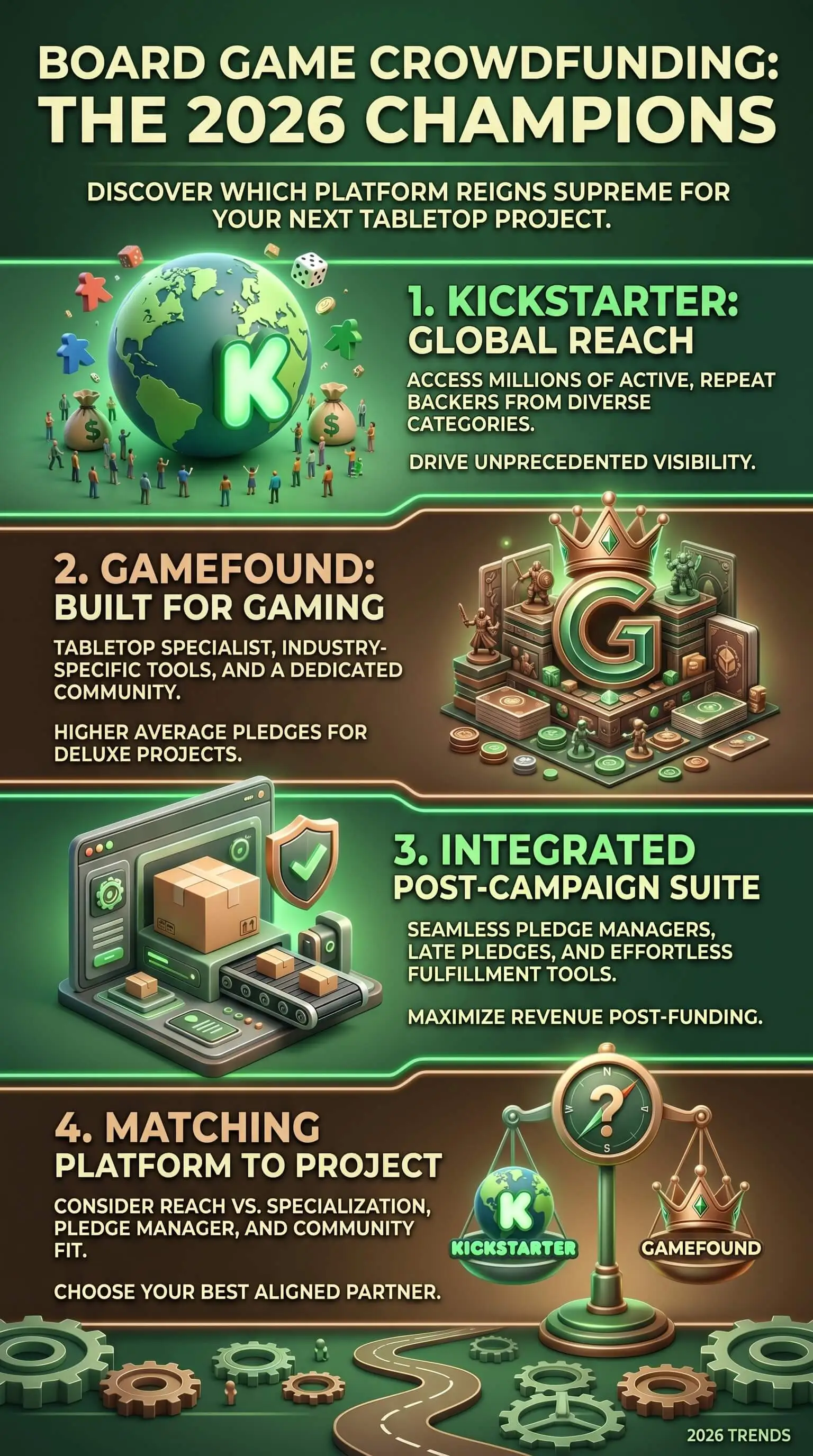
Kickstarter launched in 2009 and basically wrote the tabletop crowdfunding playbook. It's still the largest backer community in crowdfunding, period: 23 million backers and $2.63 billion pledged to games projects since launch. 2024 was the platform's biggest tabletop year ever, with roughly $220 million raised across successful campaigns at an 80% success rate.
The advantage is reach. About 70% of game backers also pledge in adjacent categories like comics, design, and publishing, which means a Kickstarter campaign can pick up crossover backers who'd never have heard of Gamefound. For a first-time creator with no audience, that kind of organic discovery is hard to find anywhere else.
Where Kickstarter falls short for tabletop is the tooling. Native pledge management didn't exist for years. Most creators still pipe their campaigns into BackerKit or Gamefound after the funding window closes. Kickstarter only added official late-pledge support in 2024, long after the tabletop world had been doing it on workarounds.
Best fit: first-time creators, projects with crossover appeal, campaigns under roughly $100K, and anyone who needs an audience to reach more than tabletop-specific features.
Gamefound: The Tabletop-Native Challenger
Gamefound started life as a pledge manager and pivoted into full crowdfunding around 2020. Since then it's grown fast inside the tabletop niche. In 2024 it captured six of the top ten most-funded tabletop campaigns, including $7.6 million for the Cyberpunk 2077 board game and $7.4 million for Lands of Evershade. The bigger headline that year was CMON, one of the largest tabletop publishers in the world, signing an exclusivity deal with Gamefound after twelve straight years on Kickstarter. CMON brought in $12.1 million across six Gamefound projects in 2024 — money that used to flow through Kickstarter.
The Gamefound pitch is simple. A tabletop-only audience with high backer intent, built-in pledge management, native late pledges, and a platform fee around 5% with payment processing on top. For creators running a sequel, an expansion, or anything large enough to draw committed tabletop backers, Gamefound has the highest concentration of intent-to-buy traffic in the category.
The trade-off is total reach. Gamefound's backer pool is smaller than Kickstarter's, and projects that need crossover discovery don't get the same lift.
Best fit: blockbuster projects, sequels, established publishers, and creators who want pledge management built into the platform.
BackerKit: The Pledge Manager Moves Upstream
BackerKit pivoted from pure pledge management into hosting launches in 2022. The argument was logical: creators were already running their post-campaign fulfillment on BackerKit, so combining launch and pledge phases on one platform cuts friction. In 2024, BackerKit raised about $23 million across tabletop campaigns. Smaller than the other two, growing fast. BackerKit now reports that TTRPG creators on its platform raise roughly twice what they raise on competing platforms.
The strengths are real: native integration between launch and fulfillment, strong support for creators with mature email lists, and pricing that mirrors Kickstarter at about 5% platform plus payment processing.
The catch is discovery. BackerKit doesn't have Kickstarter's organic browser traffic or Gamefound's saturated tabletop audience, which means a campaign launched there leans heavily on the creator's own email list. If you have that list, BackerKit is a strong fit. If you don't, you're climbing a steep hill.
Best fit: returning creators with mature email lists, projects with complex fulfillment, and TTRPG campaigns in particular.
Platform Comparison at a Glance
Kickstarter
Best for: first-time creators, crossover projects, campaigns under $100K
Platform fee: 5% + payment processing
Strongest asset: largest backer community in crowdfunding
Gamefound
Best for: blockbuster projects, sequels, publishers with established tabletop followings
Platform fee: around 5% + payment processing
Strongest asset: tabletop-only audience with built-in pledge management
BackerKit
Best for: repeat creators, mature email lists, TTRPG campaigns
Platform fee: 5% + payment processing
Strongest asset: integrated launch-to-fulfillment workflow
Why Platform Choice Is Only 20% of Your Board Game Crowdfunding Strategy
Platform choice is the easy decision. The hard work is everything that has to happen before launch day.
A board game crowdfunding strategy worth running includes an audience-building plan that goes for months, an email list large enough to credibly support your funding goal, social proof from reviewers and influencers worth listening to, a prelaunch landing page that converts traffic into signups, paid acquisition that pays back, and demo gameplay content people want to watch.
A strong campaign on Kickstarter beats a weak campaign on Gamefound every time. The reverse holds too. Platform choice can amplify what's already there. It works best when paired with strong DnD and TTRPG marketing that builds excitement, community, and pre-launch momentum before the campaign ever goes live.

“Riley James, a board game copywriter and crowdfunding strategist at Riley James Copy, makes a version of this argument from the tabletop-design side. James draws an analogy to victory-point scoring in heavy strategy games like Terra Mystica. In those games, players who bank everything on a single late-game scoring move usually lose to opponents who collected points round by round. The creators who treat their Kickstarter or Gamefound campaign page as the start of their marketing instead of part of a larger brand extension strategy tend to play the same losing pattern: they hit their funding minimums while losing money doing it.”
7 Essential Resources
These are the resources tabletop crowdfunding creators actually keep open in browser tabs. Bookmark all seven.
1. Kickstarter Creator Handbook: Kickstarter's own launch documentation. Page setup, funding mechanics, fulfillment basics, all of it. The official starting point. URL: https://www.kickstarter.com/help/handbook
2. Gamefound: The platform's main hub, with campaign showcases and creator-side resources for anyone weighing a tabletop-native launch. URL: https://gamefound.com/en
3. BackerKit: Primary site covering both BackerKit's crowdfunding hosting and the pledge management product creators already know. URL: https://www.backerkit.com/
4. Stonemaier Games Crowdfunding Lessons: Jamey Stegmaier's full archive of lessons from eight successful campaigns that raised over $3 million combined. If you read one resource on this list, read this archive. URL: https://stonemaiergames.com/kickstarter/full-list-chronological/
5. BackerKit's Tabletop Games Crowdfunding Roadmap: A step-by-step blueprint from pre-launch through fulfillment, written specifically for tabletop creators rather than general crowdfunders. URL: https://www.backerkit.com/blog/tabletop-games-crowdfunding-roadmap/
6. LaunchBoom Platform Comparison Guide: Agency-side breakdown of Kickstarter vs. Gamefound vs. BackerKit with current funding data and fee analysis. Useful as a sanity check on platform marketing claims. URL: https://www.launchboom.com/crowdfunding-guides/kickstarter-vs-gamefound-vs-backerkit/
7. Board Game Wire: Independent industry coverage tracking platform shifts, publisher moves, and campaign post-mortems. Where you'll see what creators are doing, not what platforms say they should be doing. URL: https://boardgamewire.com/
3 Statistics
1. Kickstarter raised approximately $220 million across successful tabletop campaigns in 2024, hitting an 80% project success rate, the highest in the platform's fifteen-year history. Source: Kickstarter Updates. https://updates.kickstarter.com/kickstarter-biggest-platform-for-games/
2. Gamefound captured six of the ten most-funded tabletop crowdfunding campaigns in 2024, including a $7.6 million Cyberpunk 2077 board game and the exclusivity move of major publisher CMON away from Kickstarter. Source: Board Game Wire. https://boardgamewire.com/index.php/2025/02/06/our-ambition-for-2025-is-to-be-number-one-in-tabletop-gamefound-closes-gap-on-kickstarter-again-as-crowdfunding-giants-2024-dollars-raised-remains-flat/
3. Across the three major platforms in 2024, tabletop crowdfunding totaled approximately $324 million: Kickstarter at $216.6M, Gamefound at $84.5M, and BackerKit at $23.1M. Source: LaunchBoom platform comparison data. https://www.launchboom.com/crowdfunding-guides/kickstarter-vs-gamefound-vs-backerkit/
Final Thoughts and Recommendation
The best platform depends on what you're launching and what you're bringing to launch day. A simple filter:
First campaign with no audience: start with Kickstarter for the crossover discovery.
Targeting $250K-plus with an established tabletop following: look hard at Gamefound.
Already have a mature email list and want one vendor handling launch through fulfillment: BackerKit makes sense.
What none of these platforms can do is replace the months of audience-building, list-building, and proof-building that have to happen before launch day. Creators who pick the "right" platform and skip the strategy work tend to underperform. Creators who pick the "less obvious" platform and execute well with support from top marketing agencies tend to outperform their projections. The platform decision matters. It just sits downstream of everything else.
Frequently Asked Questions
Is Kickstarter still good for board games in 2026?
Yes, particularly for first-time creators and projects under roughly $100K. Kickstarter still hosts the largest backer community in crowdfunding, and about 70% of game backers also pledge in adjacent categories, which delivers crossover discoveries you can't easily replicate anywhere else. Kickstarter's weakness is tooling, not audience.
How much does it cost to launch on Gamefound?
Gamefound's platform fee runs around 5%, with payment processing fees of roughly 3-5% on top. Total platform cost lands in the 8-10% range, in line with Kickstarter and BackerKit. Pricing details shift occasionally, so confirm current rates on Gamefound's site before you lock in your launch budget.
How long should pre-launch marketing run before opening a campaign?
Most tabletop crowdfunding specialists recommend at least six months of dedicated pre-launch work. That covers list building, social proof collection, prelaunch page optimization, and reviewer outreach. Rushing the prelaunch phase is the single most common reason campaigns hit their funding minimum and lose money overall.
Can I run the same campaign on both Kickstarter and Gamefound at the same time?
Not as a primary launch. Both platforms use an all-or-nothing funding model and require campaign exclusivity during the live funding window. Many creators do use one platform for the primary launch and another (or BackerKit) for pledge management afterward.
What's the minimum email list size for a successful board game crowdfunding campaign?
There's no universal number. Most six-figure tabletop campaigns enter launch with at least a few thousand engaged email subscribers. Engagement rate and pre-launch reservation rate matter more than raw list size. A 2,000-person list with 30% reservation engagement outperforms a 10,000-person list with 3% engagement almost every time.
What's the average success rate for tabletop crowdfunding?
Kickstarter hit an 80% success rate for tabletop in 2024, its highest in fifteen years. Gamefound and BackerKit don't publish equivalent figures, though both report similar or higher success rates within their tabletop verticals.
Your Next Move
Picking a platform is the easy decision. The harder work starts long before launch day: building the audience, building the list, gathering the social proof, and shooting the demo content that turns prospects into pledges.
If you're early in planning your board game crowdfunding strategy, the most useful thing you can do right now is shift focus away from the Kickstarter-versus-Gamefound debate and toward the months of marketing work that decide whether your launch lands. Start with the audience, especially players who already love colorful social experiences like the Hues and Cues game. The platform decision sorts itself out.