It's 9 p.m. on a Sunday, and you're matching bank transactions instead of sketching. Your six-person studio has three retainers running and a folder of freelancer invoices you haven't opened yet. It was a busy month. So why is there so little cash in the account?
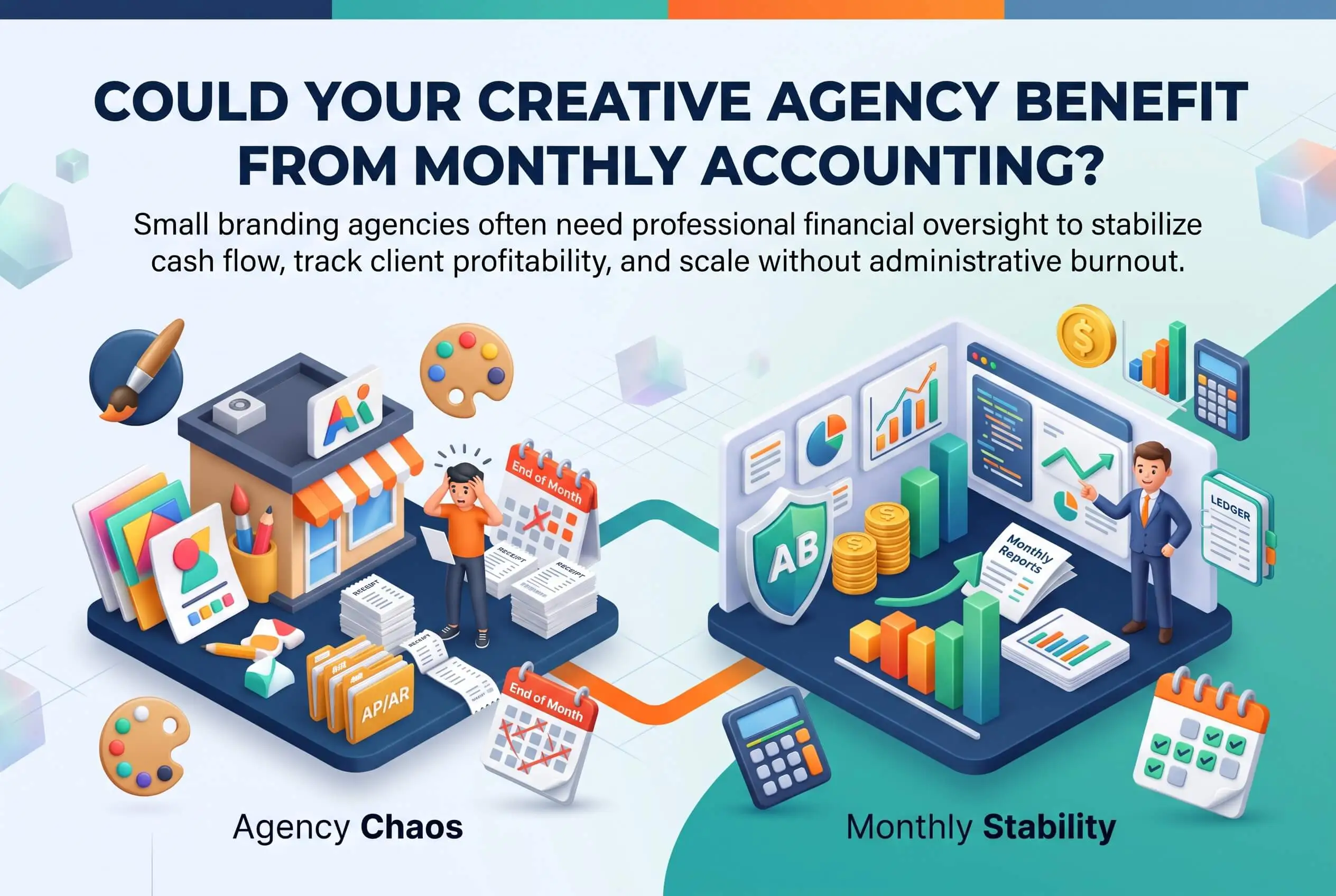
That question is usually what sends owners looking for accountants for creative agencies. Our honest answer is that most small branding agencies get their money's worth from monthly accounting once they carry retainers or pay contractors, and almost always by the time they reach five people. A solo designer with a handful of projects a year can usually get by with a bookkeeper and an annual tax accountant.
TL;DR Quick Answers
Accountants for Creative Agencies
Accountants for creative agencies go past standard bookkeeping to show profit by client, project, and retainer. For a small branding studio, that means a monthly close plus job costing, so you can see where scope creep is eating margin before renewal time.
What they track: retainer burn, team utilization, project margins, and unbilled pass-through costs.
What you get each month: a P&L, a cash view, receivables aging, and profitability by client.
Where they work: QuickBooks connected to time tracking like Harvest and payroll tools like Gusto.
What it costs: typically a few hundred dollars to about $1,500 a month for a small agency.
When you need one: once you run retainers or pay freelancers, and almost always by five people.
Top Takeaways
Most small branding agencies benefit from monthly accounting once they run retainers or pay contractors.
Somewhere around five people, doing your own books usually costs more than it saves.
Job costing shows which retainers actually make money and which ones only look like they do.
Small agencies typically pay a few hundred dollars to about $1,500 a month for ongoing support.
Solo studios doing project-only work can wait until their first hire or first retainer.
What Does Monthly Accounting Mean for a Branding Agency?
Monthly accounting means a team reconciles and closes your books every month, then walks through them with you, so you can see profit by client and cash on hand while there's still time to act on it.
That's the difference from once-a-year tax prep. An annual accountant tells you what happened last year. A monthly partner shows you what's happening now, early enough to reprice a retainer or hold off on a hire.
For a small studio, monthly support usually covers:
Bank and credit card reconciliations
Retainer and project invoicing, plus follow-up when payments run late
Freelancer and contractor payments, with 1099 records kept current
A monthly close with a profit and loss statement and balance sheet
Profitability by client or project, so you can see where margin goes
Why Branding Agencies Have Different Accounting Needs
Branding agencies don't earn money the way a retail shop does. Revenue shows up as monthly retainers, milestone payments on identity projects, and pass-through costs for printing, photography, or production. If you want a closer look at how branding agencies get paid, that piece walks through the models. For accounting purposes, the mix itself is the problem.
Scope creep hides in busy months. A retainer scoped for 20 hours quietly absorbs 35. Revenue looks fine, but the account is losing money, and nobody notices until someone tracks time against the fee.
Money goes out before it comes in. Freelancers and vendors expect payment in 15 days. Clients take 30, sometimes 60. That gap is how a full pipeline still leaves a thin bank balance, and it gets worse when a reimbursable print run never makes it onto an invoice. That's the margin you handed back to the client.
What Do Accountants for Creative Agencies Actually Do Each Month?
Good accountants for creative agencies work on a rhythm built around how agencies bill and spend. In practice, it looks something like this.
Every week, your accounting team codes transactions to the right client, project, or campaign, pays bills on schedule, and nudges open invoices before they go stale.
At month-end, the team closes your books on a set date. You get a P&L, a balance sheet, a cash view, and a receivables aging report, with a short note on what changed and why.
Once a month or once a quarter, you sit down with someone who reads the numbers with you. That conversation covers margin by client, retainer burn, utilization, and whether the next hire makes sense yet.
Job costing is the part generic bookkeeping skips. It ties every hour and every expense to a client, so you can see which accounts carry the studio and which ones drain it.
7 Signs Your Branding Agency Needs Monthly Accounting Support
1. Your Books Only Get Done at Tax Time
If your accountant sees your numbers once a year, every decision in between runs on memory and a bank balance. Catching up in March also costs more than staying current.
2. You Can't Say Which Client Is Actually Profitable
Your biggest client by revenue may not be your best by margin. Without project-level tracking, you have no way to tell.
3. Retainers Keep Absorbing Extra Rounds
One more round of logo revisions, then one more deck. If retainer hours regularly run over and you only notice at renewal, you're funding the client's work.
4. Contractor Payments Turn Into a January Scramble
Most studios lean on freelance designers, writers, and photographers. If the 1099 season means digging through Venmo and old emails to rebuild who you paid, your records need monthly attention.
5. Cash Runs Tight Even With a Full Pipeline
Busy and broke is a familiar agency pattern. It usually traces back to slow collections, unbilled pass-through costs, or payroll that lands before client payments do.
6. You're Spending Design Hours on Bookkeeping
Every hour you spend reconciling accounts is an hour you didn't bill or spend winning work. For most owners, that trade stops making sense pretty quickly.
7. A Loan, Partner, or Sale Is Coming
Banks, investors, and buyers want clean, consistent statements. With monthly books, that request becomes routine instead of a fire drill.
How Much Do Monthly Accounting Services Cost for a Small Agency?
Most small agencies spend somewhere between a few hundred dollars and about $1,500 a month on ongoing support. Where you land depends on transaction volume and how much reporting you want.
Software and DIY: Subscription plus your time. Cover whatever you do yourself. Best for solo designers with very low volume.
Freelance bookkeeper: Usually hourly, varying by volume. Covers data entry and reconciliations. Best for simple books where the owner handles the analysis.
Agency-focused bookkeeping: From $250 a month, or $500 to $1,200 with per-client job costing (Catalyst CPA). Covers monthly books plus client-level profit. Best for small studios with retainers.
Outsourced accounting team: From about $870 a month for bookkeeping and about $1,500 a month for full accounting (Accountix pricing, billed weekly). Covers the close, AP/AR, payroll, reporting, and review meetings. Best for growing agencies with staff and contractors.
In-house accountant: $83,680 median salary before benefits, as of May 2025 (BLS). Covers one person's skills and hours. Best for larger firms that need someone on site.
Whichever route you pick, ask for a fixed monthly fee tied to a written scope. Hourly billing with no defined scope turns every new client into a surprise on your invoice.
Is It Worth It? What Monthly Accounting Actually Pays For
Saving a few hours a month is nice. The bigger payoff is making decisions sooner.
Here's a hypothetical built on a pattern we run into often. A studio has a $6,000 monthly retainer it thinks of as its anchor account. After three months of job costing, the reports show the team putting about 70 hours a month into it. At a blended cost of $95 an hour, that's $6,650 in labor, so the anchor account loses money every month.
The fix might be a scope reset, a price increase, or different staffing. None of those conversations happen until someone puts the number in front of the owner, and that one correction can cover a year of accounting fees.
When Monthly Accounting Isn't Worth It Yet
We'll be straight with you. Not every studio needs this today.
If you're a solo designer doing a few fixed-fee projects, with no contractors and no retainers, monthly accounting is probably more than you need. A quarterly cleanup and a good tax accountant will cover you.
Come back to the question when you sign your first retainer, make your first hire, or hit a month where you can't explain where the cash went.
DIY, Bookkeeper, Outsourced Team, or In-House Hire?
DIY: You do the work, monthly reporting happens only if you make time, agency-specific insight is low, and the books stop whenever you get busy.
Freelance bookkeeper: One person does the work, reporting is basic, insight ranges from low to moderate, and your books stall if they leave.
Outsourced accounting team: A preparer, reviewer, and senior lead share the work. You get a set close date and report package, job costing and retainer tracking, and coverage when anyone is out.
In-house hire: One employee does the work, reporting and insight depend on who you hire, and a departure leaves a hiring gap.
If you're already past this stage and wondering whether an outsourced firm can scale with you, that's a separate checklist worth working through.
"When we start with a small creative firm, sloppy bookkeeping is rarely the first problem we find. More often it's a retainer that looks healthy on revenue and loses money once you put time against it. Owners usually know which client feels heavy. What they're missing is the number. In our experience helping creative firms spot margin leaks, the first two or three monthly closes with job costing change more decisions than anything else we do, because the conversation moves from 'we're slammed' to 'this account costs us $600 a month to keep.' You can test this yourself this month. Take your biggest retainer, add up the hours your team logged on it, multiply by what those hours cost you, and compare that to the fee. If you can't pull the hours, you have your answer."
7 Essential Resources
When agency owners want to check what we tell them against the original source, these are the places we send them.
1. Set Up Records That Will Hold Up
IRS Publication 583 covers which records every business should keep, how long to keep them, and why the bank account gets reconciled every month. Think of it as the plain-English baseline for any studio's books.
Source: IRS Publication 583, Starting a Business and Keeping Records
2. Report Freelancer Payments Correctly
Pay freelance designers, writers, or photographers, and Form 1099-NEC is how you report it. The IRS page links to the current form and its filing instructions.
Source: IRS, About Form 1099-NEC, Nonemployee Compensation
3. Classify Contractors Before It Becomes a Problem
Studios that keep the same freelancers on for years should know where the employee line sits. Publication 15-A lays out the behavioral, financial, and relationship tests the IRS applies.
Source: IRS Publication 15-A, Employer's Supplemental Tax Guide
4. Know Who Should Own Each Finance Task
The SBA's finance guidance compares cash and accrual accounting and lists the tasks someone on your side has to own, from receivables and payables to bank reconciliation and payroll. It also spells out where a bookkeeper's work ends and a CPA's begins.
Source: U.S. Small Business Administration, Manage Your Finances
5. Map Your Cash Month by Month
SCORE's free 12-month cash flow template lets you line up retainer payments against payroll and vendor bills. It's the quickest way we know to spot the thin months before they arrive.
Source: SCORE, 12 Month Cash Flow Statement Template
6. Write Scope and Payment Terms That Protect Margin
A lot of scope creep starts in the contract. AIGA's standard agreement gives design firms modular terms and conditions to attach to their own proposals.
Source: AIGA Standard Form of Agreement for Design Services
7. Understand What Accountants Actually Do
The Bureau of Labor Statistics profile covers what accountants do, the credentials they hold, and what they earn. It's a helpful context when you're weighing an outside firm against a hire.
Source: U.S. Bureau of Labor Statistics, Occupational Outlook Handbook: Accountants and Auditors
3 Statistics
1. Most Small Businesses Are Waiting on Money They've Earned
In QuickBooks' 2026 late payments research, 59% of small businesses had invoices overdue by 30 days or more, up from 47% the year before. Businesses waiting on unpaid invoices were owed $17,700 on average. For a small studio running on retainers and milestone payments, that can be a full month of payroll sitting in a client's account.
Source: Intuit QuickBooks, 2026 Small Business Late Payments Report
2. Late Payments Got Worse in Early 2026
Xero's small business data shows US small businesses were paid an average of 9 days late in the first quarter of 2026, up from 8.4 days the quarter before. All told, they waited 28.8 days to get paid. A monthly close is where someone catches that drift before it becomes a payroll problem.
Source: Xero, Late Payments Are Climbing Again
3. Even an In-House Bookkeeper Is a Real Fixed Cost
The median annual wage for bookkeeping, accounting, and auditing clerks was $50,670 in May 2025, before benefits and payroll taxes. That's a full salary for work that rarely fills 40 hours a week at a small studio, which is why so many agencies outsource it.
With 59% of small businesses reporting invoices overdue by 30 days or more, payment delays averaging 9 days, and in-house bookkeeping salaries reaching $50,670 annually, black-owned marketing agencies can benefit from professional financial management. Outsourced accounting and bookkeeping services can help these agencies track overdue payments, improve cash flow, reduce fixed costs, and maintain financial stability while focusing on business growth.
Final Thoughts and Opinion
We've been doing this work since 2015, and our view is simple. Monthly accounting earns its fee when it changes a decision. If the reports never lead you to reprice a retainer or bill a forgotten pass-through cost, you're paying for tidy books and not much else.
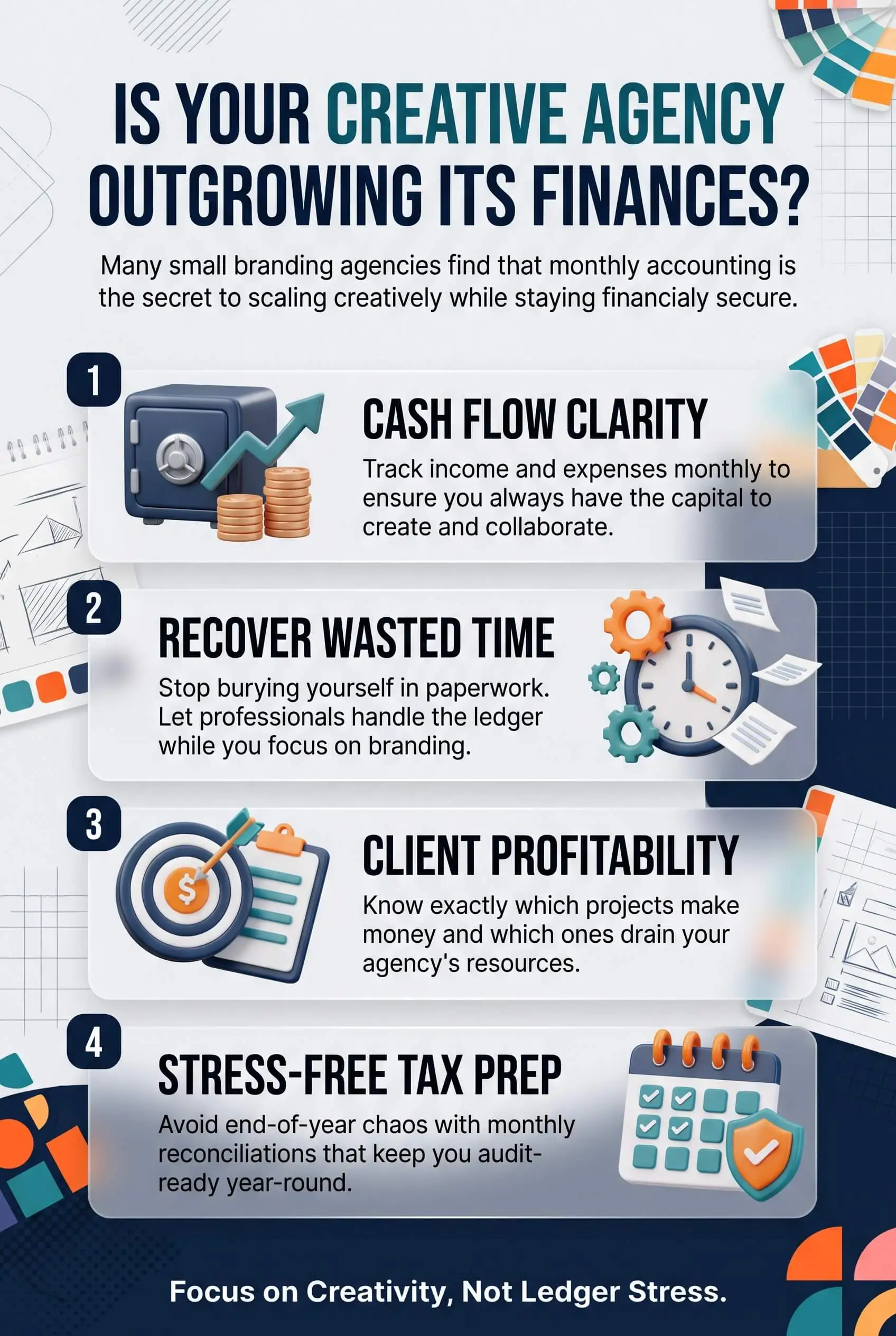
For most small branding agencies, those decisions are already sitting there. Retainers and freelancers come with the business model, and so does lumpy cash flow. What's usually missing is someone putting the numbers in front of you every month, early enough to do something about them.
That's the work good accountants for creative agencies do through professional accounting services. Compliance matters, but what you're paying for is visibility. You shouldn't have to guess which clients carry the studio and which ones quietly drain it.
And if you're solo, project-based, and not paying contractors, wait. Keep your books clean with help from a good tax accountant, and come back to this the month you sign your first retainer.
Frequently Asked Questions
Do small branding agencies really need an accountant, or is a bookkeeper enough?
A bookkeeper records and reconciles your transactions. An accountant turns those records into reports, closes the month, and helps you read what the numbers say. Very small studios can start with a bookkeeper and an annual tax accountant. Once you carry retainers or a team, you'll want both, and it's simpler when one firm handles both.
How much do accountants for creative agencies charge per month?
Most small agencies pay anywhere from a few hundred dollars to about $1,500 a month, depending on transaction volume, payroll, and how much reporting they want. Agency-focused bookkeeping with job costing tends to land in the middle of that range. Ask for a fixed monthly fee tied to a written scope.
What's the difference between monthly bookkeeping and monthly accounting?
Monthly bookkeeping records and reconciles what happened. Monthly accounting adds the close, financial statements, receivables and payables management, and a review of what it all means. For an agency, it should include profitability by client too.
When should a design studio switch from cash to accrual accounting?
Accrual accounting matches revenue to the month you earned it, which gives you a truer picture of retainers and long projects. Many studios switch when a lender asks for accrual statements or when cash-basis reports stop making sense. Talk to your tax accountant before you change, since switching methods can require IRS approval.
Can a monthly accountant help with freelancer 1099s?
Yes. A good monthly partner collects W-9s as freelancers come on board, tracks what you pay each one throughout the year, and has your 1099-NEC data ready in January. A stressful week turns into a quick review.
What should I ask before hiring an accounting firm for my agency?
Ask whether they already work with creative firms and whether they can track profitability by client or retainer. Find out which time-tracking and project tools they support, what date your books will close each month, and how pricing changes as you grow.
Find Out If Your Agency Is Ready for Monthly Support
You don't have to decide anything today. Start with a quick look at where you stand.
List your active retainers and the hours your team logged on each one last month.
Check how far behind your books are right now.
Estimate how many hours a week you spend on invoicing, bills, and bookkeeping.
Ask yourself which client you'd be least sorry to lose, and whether the numbers back that up.
If any of those answers make you uneasy, book a 30-minute intro call with Accountix to explore how trusted accounting services can help. There's no obligation, just clarity about your numbers and whether monthly support makes sense for your agency right now.


