Imagine your biggest client just doubled its retainer. You've hired two people in another state, your bank wants financial statements by Friday, and last month's books still aren't closed.
Most owners start asking whether their accounting can keep up right about then. Growth rarely breaks an accounting setup in one crash. It wears it down, a few hundred extra transactions and one new payroll state at a time, until your numbers stop telling you the story you need to hear.
Here's the short answer to the question in the title. An outsourced accounting firm can handle your growth if it can already support the business you'll be in 18 months from now, with the services, people, systems, and pricing to prove it. The rest of this page shows you how to check. And if you're still deciding why growing companies outsource accounting at all, start with that piece first.
TL;DR Quick Answers
Best Outsourced Business and Financial Accounting Firms
The best outsourced business and financial accounting firms are the ones you won't outgrow. Look for a firm that:
Covers every stage. Bookkeeping, outsourced accounting, and fractional CFO support on one team.
Puts a team on your account. A preparer, a reviewer, and a senior lead, so nothing stalls when one person is out.
Close your books on a set date. You get the same monthly report package, on time, every month.
Connect to the tools you already use. Cloud systems, with the logins in your name.
Prices by scope. A fixed monthly fee means no surprises as you grow.
Has grown businesses like yours. Ask for a reference from a client one stage ahead of you.
Our rule of thumb for choosing the best outsourced business and financial accounting firms: if a firm can't tell you what your books will need at twice your size, keep looking.
Top Takeaways
Judge the firm by your next stage. What you need today tells you very little about whether they can keep up.
Keep it under one roof. A partner that covers bookkeeping, accounting, and fractional CFO work saves you from switching firms mid-growth.
Ask who's actually on your account. A reviewed team beats a single bookkeeper every time.
Get the close date in writing. Along with a sample of the monthly package you'll receive.
Choose fixed, scoped pricing. Hourly billing punishes you for growing.
What Does Handling Growth Actually Mean for Your Accounting?
It means your books keep up with each new milestone, and more transactions are only a small part of that. Bookkeeping records what happened. Financial accounting turns those records into statements a lender, investor, or auditor will trust. Most growing businesses cross from the first job into the second without noticing until someone asks for proof.
Watch for these triggers:
More clients and transactions: Your team has to reconcile faster, and someone has to chase receivables before cash gets tight.
New hires: Payroll and benefits get more complicated, especially once you have people in a second state.
A second location or entity: Now you need consolidated books and clean tracking of money moving between entities.
A loan or line of credit: Lenders usually want accrual-basis statements and covenant reports on their schedule, not yours.
Investors or a sale: Due diligence exposes every shortcut, so your statements have to be consistent year over year.
7 Ways to Tell if an Outsourced Accounting Firm Can Scale With You
1. It Offers a Clear Path From Bookkeeping to CFO-Level Support
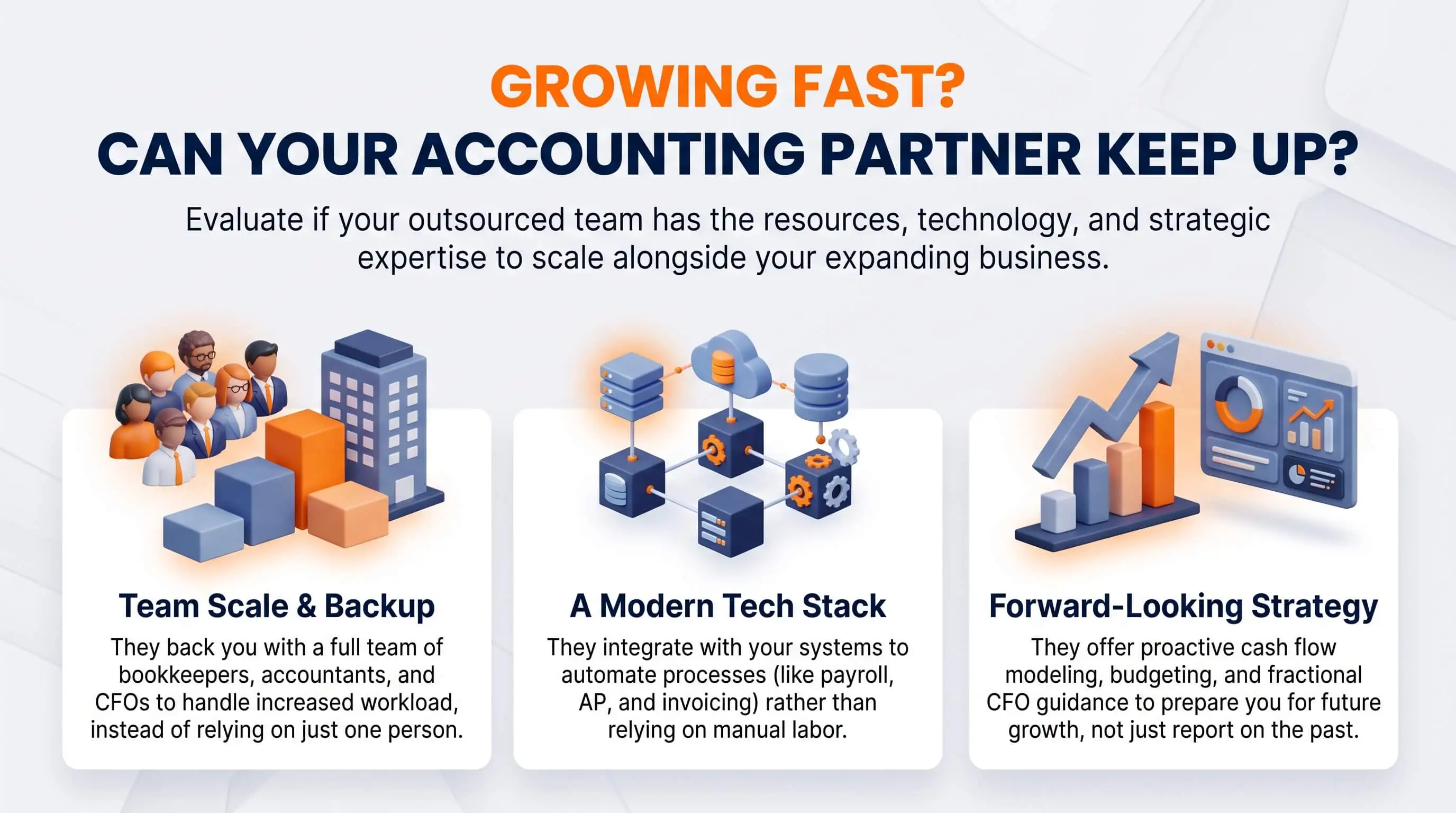
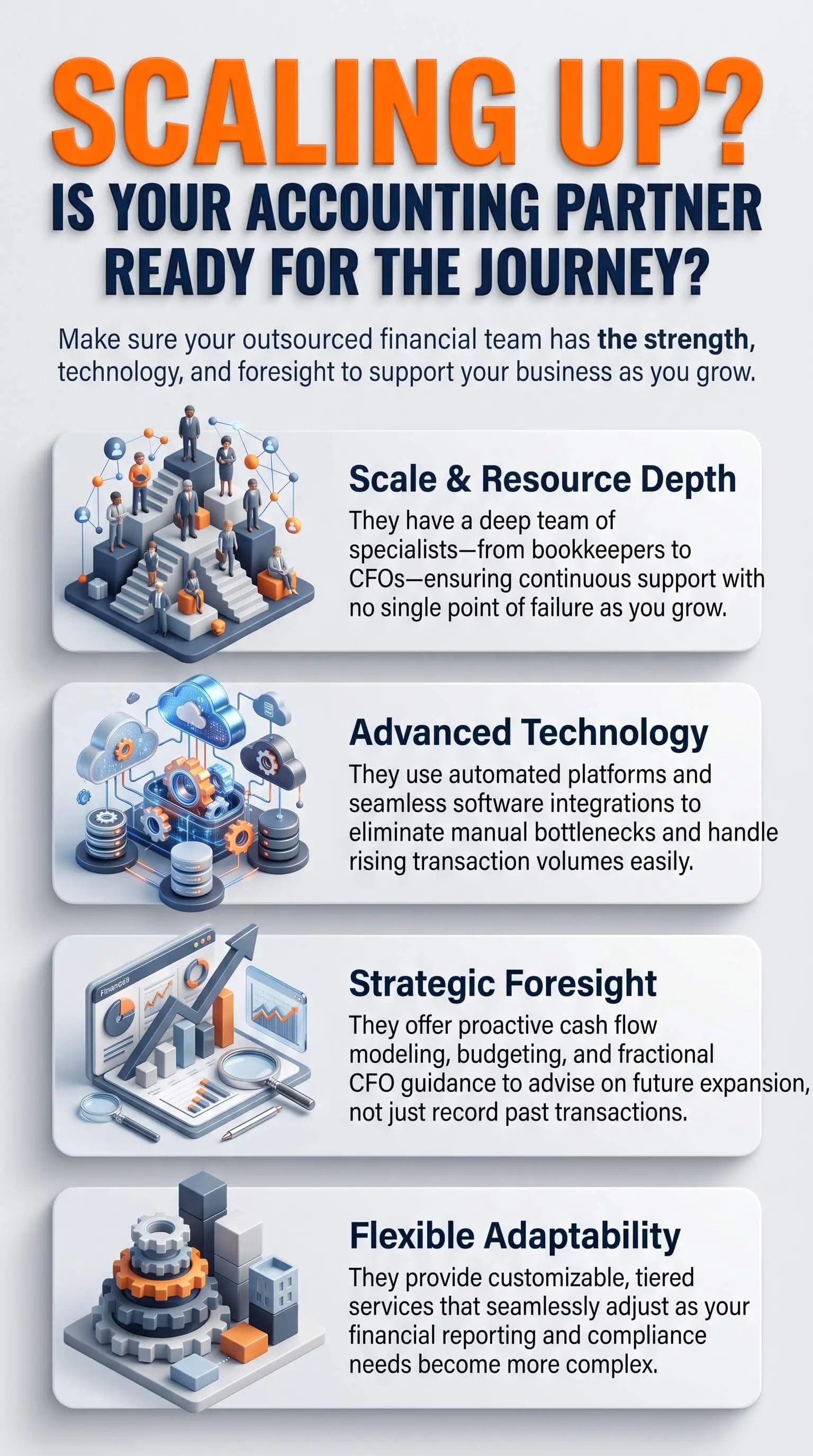
A firm that can grow with you has more than one gear. Early on, you might only need clean books. A year or two later, you need a full accounting department, and eventually someone to help you forecast and make bigger calls.
If all of that lives under one roof, you skip the painful part where you switch providers and rebuild your history at every milestone. We built Accountix as an outsourced accounting firm that grows with you for exactly that reason, with bookkeeping, outsourced accounting, and fractional CFO support on one team. Ask any firm you're considering: "What would you add for us at twice our size?"
2. It Puts a Team on Your Books
One great bookkeeper is still one person, and one person gets sick, takes vacation, and eventually moves on. Look for a setup where someone prepares the work, someone else reviews it, and a senior accountant or controller signs off. Ask who covers your account when your main contact is out.
3. Its Systems Can Handle More Volume
Manual entry that works at 200 transactions a month falls apart at 2,000. A firm ready for growth runs cloud accounting connected to bill pay, expenses, payroll, and the tools you already use, like your CRM or project software. Confirm up front that the accounts and logins are in your name, so your data stays yours.
4. It Closes Your Books on a Set Date
A dependable firm can tell you the day your month closes and what lands in your inbox when it does. That monthly package usually includes a profit and loss statement, a balance sheet, a cash flow view, receivables and payables aging, and a few notes on what changed and why. If a firm can't name the date, you'll be waiting on it.
5. It's Ready for Complexity You Don't Have Yet
The right partner is already prepared for next year's problems. Think converting from cash to accrual, recognizing retainer and project revenue correctly, tracking profitability by client, managing more than one entity, and staying current on sales tax. For agencies, profitability by client is where the biggest surprises tend to hide.
6. Its Pricing Grows Predictably
A fixed monthly fee tied to a defined scope means no surprises on your invoice. Ask what would move you to the next tier and get the answer in writing. Open-ended hourly billing works against you here, because every new transaction becomes a new charge.
7. It Has Grown Businesses Like Yours
Ask for a case study or a reference from a client one stage ahead of you, ideally in your industry. A firm that has already taken a creative agency from ten people to forty knows exactly where the cracks show up.
Scalability Scorecard: Questions to Ask Before You Sign
What separates the best outsourced business and financial accounting firms from the rest is how clearly they answer these questions.
What would you add for us as we grow? A strong answer lays out a path from bookkeeping to fractional CFO. Be wary of "We'd refer you elsewhere."
Who actually works on our account? You want a named preparer, a reviewer, and a senior lead. One person with no backup is a warning sign.
What systems will we use, and who owns them? Look for a cloud setup that connects to your tools, with logins in your name.
When will our books close each month? A specific date and a defined report package. "As soon as we can" isn't an answer.
Can you handle accrual, multi-entity, and project accounting? Ask for examples. Cash-basis-only firms will struggle as you grow.
How does pricing change as we grow? Written tiers with clear triggers beat open-ended hourly billing.
Can we talk to a client at our next stage? A confident firm says yes. No references is a red flag.
How do you protect our financial data? Listen for role-based access, multi-factor authentication, and written policies rather than vague reassurance.
Red Flags That a Firm Will Struggle as You Grow
One person does everything, and nobody covers your account when they're out.
The firm can't tell you when your books will close.
You don't have admin access to your own accounting system.
Cash-basis bookkeeping is the only option on the menu.
Billing is hourly with no defined scope.
Matching Accounting Support to Your Growth Stage
Early stage: You need clean, reconciled books and basic payroll. Bookkeeping covers it.
Growing stage: Accrual accounting, a reliable monthly close, and a clear view of cash. That's the job of an outsourced accounting department.
Scaling stage: Forecasts, budgets, lender or investor reporting, and pricing decisions start driving the business. Add a fractional CFO on top of your accounting team.
Most businesses move through these one step at a time. A single partner that covers all three saves you from rebuilding your finance function at every step.
"Most of the time, the problem we walk into isn't a bad accountant. It's a perfectly good setup built for a smaller company. When a client adds a second entity or takes on a line of credit, the first thing we usually rebuild is the chart of accounts. Someone built it to get taxes filed, and now it has to tell you which clients actually make you money. So here's our advice before you sign with anyone. Hand them your plan for the next year and a half and ask them to walk you through what changes in your books at each step. If they answer in specifics, they've done it before. If they answer in generalities, you'll be paying for them to learn."
7 Essential Resources
When clients want to double-check a firm's answers on their own, these are the primary sources we send them to.
1. Understand Cash vs. Accrual Before Anyone Asks You to Switch
IRS Publication 538 covers accounting periods and methods, including when a change needs IRS approval. Skim it before a firm recommends moving to accrual, so you know what's changing and why.
Source: IRS Publication 538, Accounting Periods and Methods
2. Brush Up on the Basics of Business Finances
The SBA's guide to managing your business walks through balance sheets, choosing an accounting method, and when to bring in a CPA or bookkeeper. It also lists the core tasks someone on your side has to own, from receivables to payroll.
Source: U.S. Small Business Administration, Manage Your Business
3. Know Where GAAP Comes From
The Financial Accounting Standards Board maintains GAAP in the U.S. When a lender or investor asks for GAAP-based statements, these are the rules they mean.
Source: Financial Accounting Standards Board (FASB)
4. Classify Workers Correctly While You're Hiring Fast
Quick growth often brings a mix of employees and contractors. The IRS explains how to tell them apart, which drives payroll taxes, withholding, and your penalty exposure if you get it wrong.
Source: IRS, Independent Contractor (Self-Employed) or Employee?
5. Pick the Right Tax Year as Your Structure Changes
Adding an entity or restructuring can put your tax year back on the table. The IRS spells out how calendar, fiscal, and short tax years work.
Source: IRS, Tax Years
6. Hold Your Firm to a Clear Security Standard
Any outsourced firm will touch your bank, payroll, and accounting logins. CISA's small business resources give you a baseline to measure a firm's security practices against.
Source: Cybersecurity and Infrastructure Security Agency, Small Business Resources
7. Keep Customer and Financial Data Safe
The FTC's small business guidance covers protecting sensitive data and spotting the scams that go after small businesses.
Source: Federal Trade Commission, Small Business Guidance
3 Statistics
1. Small Businesses Carry a Big Share of U.S. Payroll
Small businesses pay 38.7% of all private-sector payroll and employ 62.3 million people, or 45.9% of private-sector workers. For a lot of growing firms, payroll is one of the largest financial processes they run every month, and it's the one employees notice first when something goes wrong.
Source: SBA Office of Advocacy, Frequently Asked Questions About Small Business 2026
2. One In-House Accountant Is a Significant Fixed Cost
The median annual wage for accountants and auditors was $81,680 in May 2024. Add benefits, payroll taxes, software, and training on top of that. And after all of it, you still have one person's skills and one person's hours.
Source: U.S. Bureau of Labor Statistics, Occupational Outlook Handbook: Accountants and Auditors
3. Good Accountants Are Always in Demand
BLS projects about 124,200 openings for accountants and auditors each year, on average, from 2024 to 2034, many of them to replace people who retire or change careers. If your only accountant leaves, your books can stall while you compete for a replacement. That's a big reason team depth matters.
Source: U.S. Bureau of Labor Statistics, Occupational Outlook Handbook: Accountants and Auditors
An outsourced accounting firm for eCommerce startups can provide the team depth, payroll support, and financial expertise growing businesses need without the fixed cost and hiring risk of relying on a single in-house accountant.
Final Thoughts and Opinion
After more than ten years of helping teams move from stressed and reactive to structured and strategic, we've come to one conclusion. The right outsourced accounting firm is the one you won't have to replace at your next milestone.
Price matters. So does a friendly point of contact. But the test that counts is whether a firm can describe, in plain terms, what your books will need when you're twice the size, and whether it already has the people and systems to deliver.
We'll be honest about the limits, too. Outsourcing isn't the right fit for every business. If you need someone on site every day, or you're big enough to justify a full internal finance department, an in-house team may serve you better. For most growing agencies, service firms, and nonprofits, though, one partner that covers bookkeeping through CFO-level advice lets you grow without rebuilding your finance function every couple of years.
Whoever you choose, run them through the scorecard above before you sign.
Frequently Asked Questions
How do I know when my business has outgrown its bookkeeper?
The books close later every month, the reports don't answer your questions about cash or profit, or a lender starts asking for accrual-based statements. If you're adding people, entities, or states faster than your bookkeeper can keep up, you need an accounting function, not just more data entry.
Is an outsourced accounting firm cheaper than hiring an in-house accountant?
Often, yes, once you count what a hire really costs: salary, benefits, payroll taxes, software, and training. You also get several skill levels for one monthly fee instead of one person's. Compare the firm's price to the fully loaded cost of the role you'd otherwise hire.
What's the difference between outsourced accounting and a fractional CFO?
Outsourced accounting keeps your books accurate and on time, from reconciliations and payables to the monthly close. A fractional CFO uses those numbers to plan ahead with budgets, forecasts, pricing, and financing. Most growing businesses need the accounting first and add CFO support as the decisions get bigger.
Can an outsourced accounting firm work with the software I already use?
It should. A firm built for growth connects to your existing CRM, project, payroll, and expense tools instead of forcing you to start over. Ask which systems it supports, and make sure the accounts and logins stay in your name.
How long does it take to switch to an outsourced accounting firm?
The transition timeline depends on how current and accurate the books are. If the accounts are fully reconciled and up to date, onboarding can move more efficiently than when a firm must first address prior-period cleanup. For black-owned marketing agencies, ask for a written onboarding plan with clear dates, including when you can expect to receive your first monthly close package.
Is my financial data safe with an outsourced accounting firm?
It can be, if the firm uses role-based access, multi-factor authentication, secure cloud platforms, and written security policies. Ask how it grants and removes access, then compare its answers to CISA's guidance for small businesses.
Put Your Accounting Partner to the Test
Your next milestone will reveal whether your accounting can keep up. It's a lot less stressful to find out now than in the middle of a loan application.
Write down the growth triggers you expect over the next 12 months.
Score your current or prospective firm against the scorecard above.
Ask for a sample monthly close package and a written onboarding plan.
Talk to a client who's one stage ahead of you.
Want a broader starting point? Our general checklist for choosing a firm covers the basics. When you're ready to talk through your own numbers, book an intro call with Accountix Solutions. It's a 30-minute conversation with no obligation, just a clear picture of what your books will need as you grow.